
The Manali–Leh journey is one of the most recognisable high-altitude adventures in the Indian Himalayas. For international travellers, however, there is an important question before the journey even begins: should you experience the Himalayas from the saddle of a motorcycle, or from the pedals of a bicycle?
At first glance both appear to follow the same basic idea — start in the mountains around Manali, cross some of the highest roads and passes in the region, and eventually reach Ladakh. In reality they are very different expeditions.
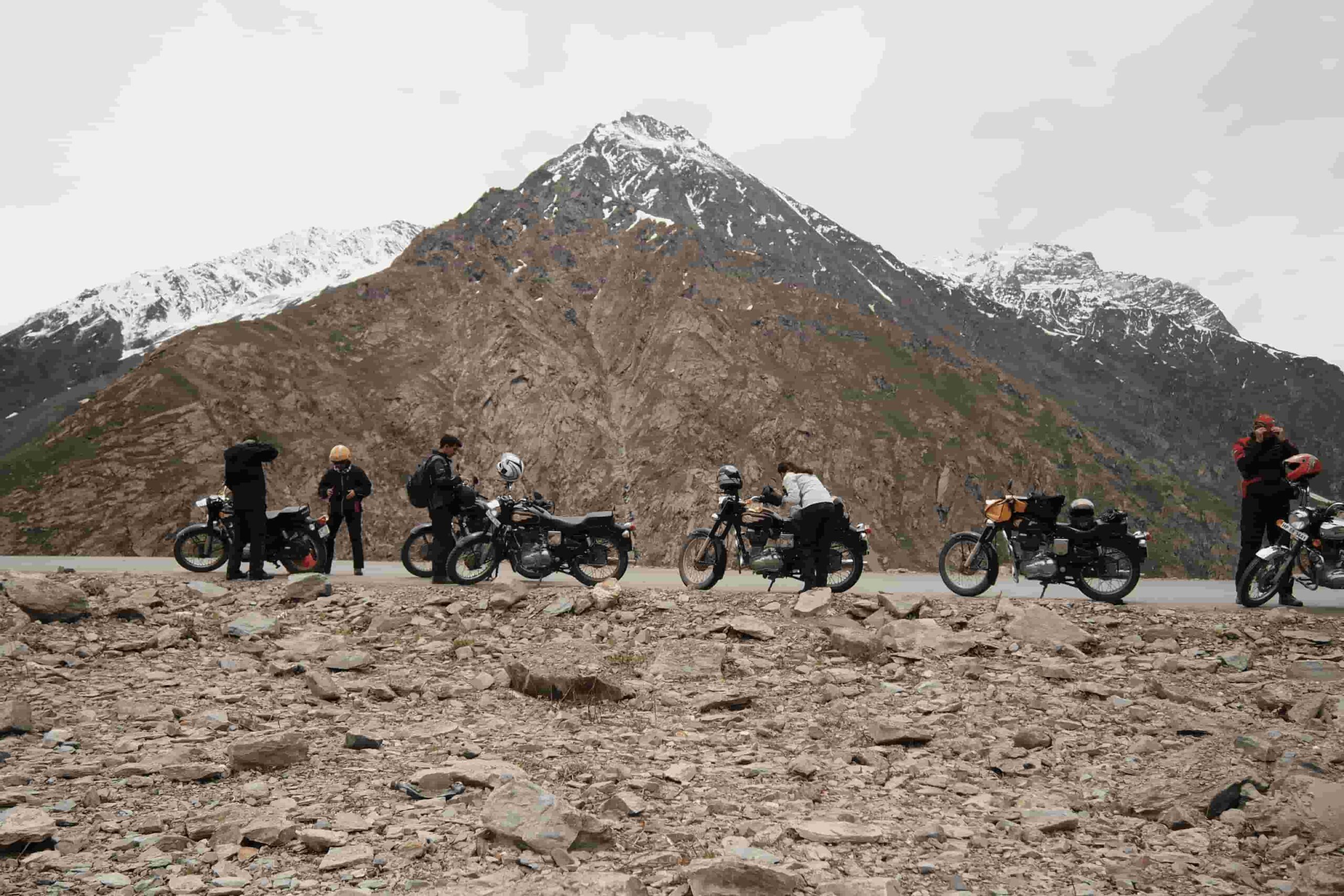
A motorcycle allows you to cover greater distances and connect more remote areas within a limited number of days. Cycling turns the same Himalayan environment into a sustained physical challenge, where elevation gain, pacing, recovery and consecutive riding days become central to the experience. Neither should be understood simply as an easier or harder version of the other.
The better question is: which type of Himalayan journey matches the way you want to experience the mountains? This guide compares motorcycle and cycling expeditions through the factors that actually matter when planning — route, distance, altitude, physical effort, terrain, preparation, acclimatisation, equipment, support, time and the overall experience.
Manali–Leh: the Himalayan journey behind the name
The Manali–Leh corridor connects the western Himalayas of Himachal Pradesh with the high-altitude landscapes of Ladakh. The journey crosses the dramatic transition from the greener valleys around Manali and Lahaul into the much drier, higher country towards Ladakh.
One of its defining features is the succession of major mountain passes. Baralacha La stands at roughly 4,890 metres and forms an important geographical divide on the route, connecting the road corridor between Manali, Keylong and Leh. Further on, the route crosses Nakee La, Lachulung La and Tanglang La, depending on the exact itinerary and current road routing.
The important thing to understand is that Manali–Leh is not simply a long road between two towns. It is a transition through several different Himalayan environments. For a cyclist that means sustained climbing, long riding days and significant physiological stress. For a motorcyclist it means managing altitude, weather, road surfaces, machine performance and long hours in the saddle while covering considerably more ground.
Motorcycle vs cycling: the fundamental difference
The easiest way to understand the difference is this: motorcycling makes the Himalayas geographically bigger; cycling makes them physically closer.
On a motorcycle you can cover substantial distances in a day and reach valleys, passes and settlements that would need considerably more time by bicycle. Cycling changes the scale of the journey. A climb that takes a motorcycle rider a short period becomes a major physical component of the cyclist’s day. Every pass is climbed under your own power. Every descent requires concentration. Every kilometre becomes part of the endurance challenge.
That changes how you experience the landscape. A motorcycle expedition is primarily a mountain riding and exploration experience. A cycling expedition is primarily an endurance and mountain-travel experience. Both can be expedition-style journeys, but the demands are different.
Manali–Leh by motorcycle
A motorcycle suits travellers who want to experience a large geographical section of the Himalayas within a limited number of days. It provides the ability to:
- Cover longer daily distances
- Cross several major passes
- Reach remote valleys
- Combine riding with cultural exploration
- Travel between widely separated destinations
- Carry personal riding equipment while using expedition support
- Explore routes beyond the core Manali–Leh corridor
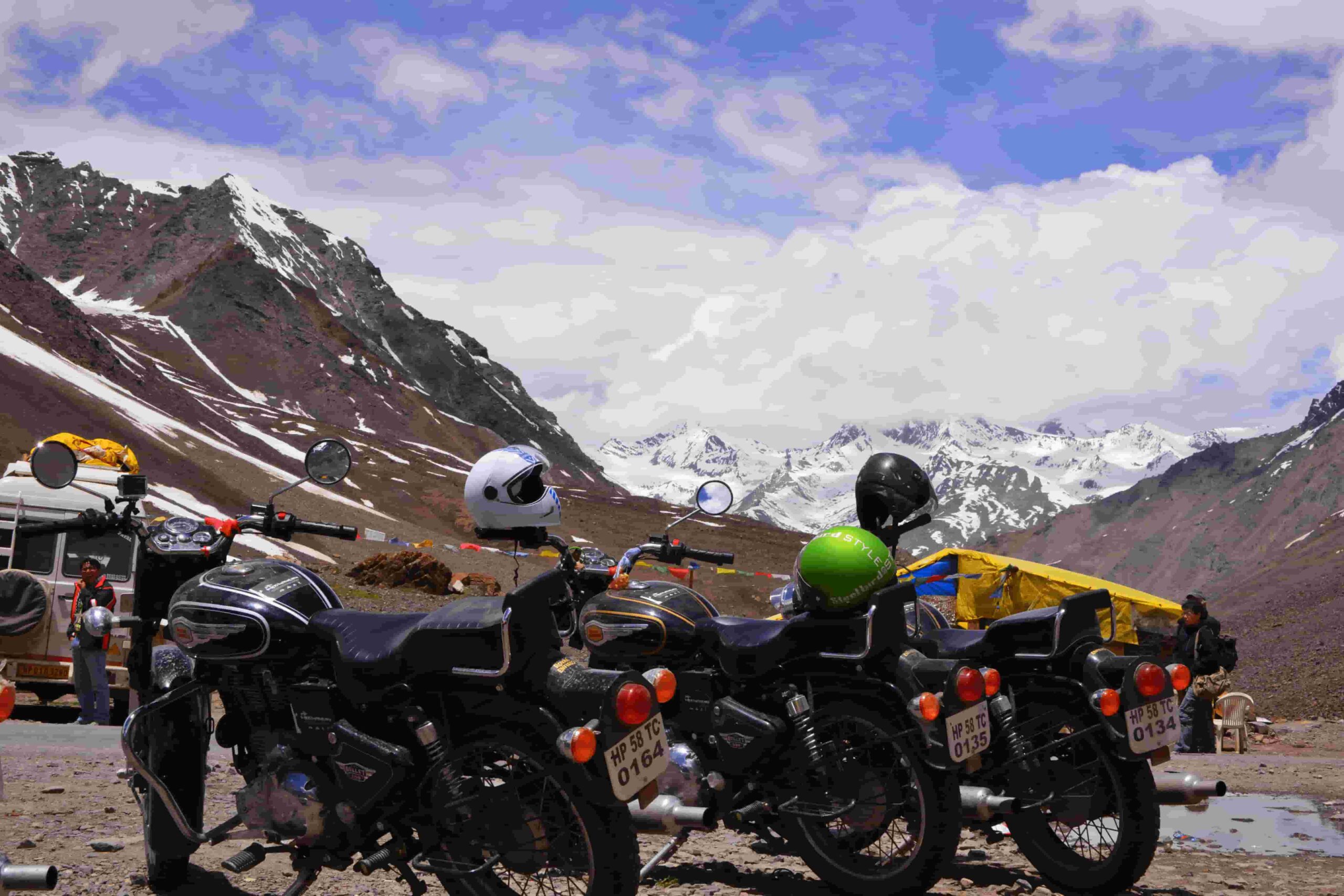
The motorcycle does not remove the effects of altitude, and that distinction matters. A rider still has to acclimatise, manage fatigue, stay hydrated, cope with cold, and recognise that high-altitude riding places different demands on both body and machine. Our motorcycle expeditions use professional road leadership, mechanical support and 4×4 backup, with luggage carried separately on the published itineraries — support that becomes particularly valuable once the route moves into remote high-altitude terrain.
Manali–Leh by bicycle
Cycling changes the same Himalayan environment completely, because the bicycle makes the rider responsible for every climb. The physical challenge is determined by far more than total distance. It depends on elevation gain, gradient, altitude, road surface, wind, temperature, daily riding duration, recovery between stages and the number of consecutive riding days.
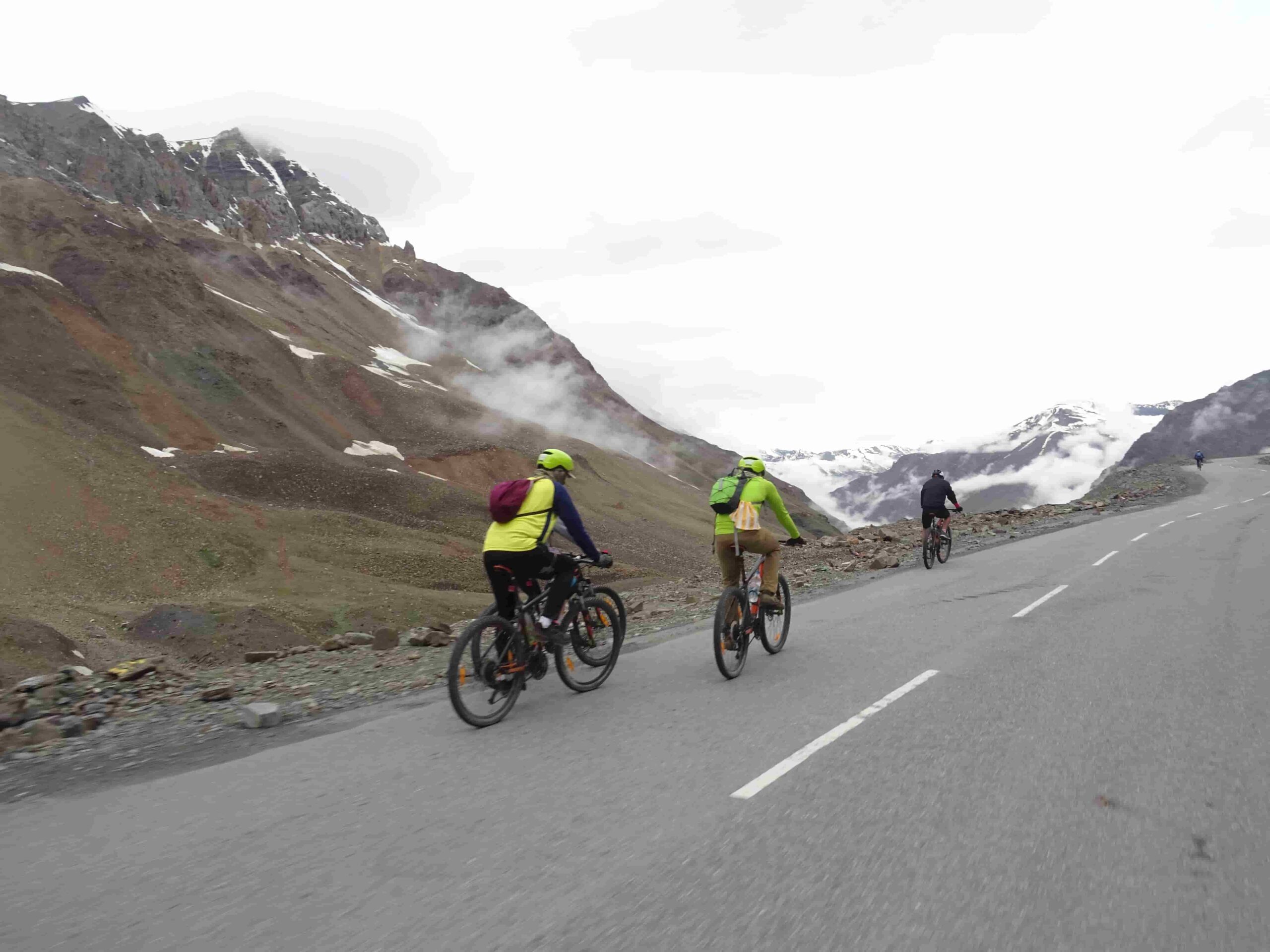
A cyclist who rides 100 kilometres comfortably at low altitude may find a significantly shorter Himalayan stage much more demanding when it includes sustained climbing above 4,000 metres. Altitude reduces exercise capacity even after acclimatisation — current CDC guidance explains that reduced oxygen availability affects physical performance, and that maximal exercise performance remains lower at high altitude than at low altitude. That is why a Himalayan cycling itinerary has to be designed around both cycling performance and altitude management.
Is cycling harder than motorcycle riding?
It would be tempting to simply say yes, but that is too simplistic. The physical workload of cycling is obviously much greater, because the bicycle provides no mechanical assistance. Motorcycle riding, however, introduces its own demands: concentration for long periods, handling on loose or broken surfaces, high-altitude fatigue, cold exposure, long riding days, mountain-road hazards, mechanical considerations and managing the machine at altitude.
A fairer comparison looks like this:
| Factor | Motorcycle | Bicycle |
|---|---|---|
| Propulsion | Engine-assisted | Rider-powered |
| Physical endurance | Moderate to high | High to very high |
| Climbing effort | Motorcycle-assisted | Entirely rider-powered |
| Daily distance | Generally higher | Generally lower |
| Altitude exposure | Significant | Significant |
| Recovery requirement | Important | Critical |
| Mechanics | Motorcycle-specific | Bicycle-specific |
| Road concentration | High | High |
| Weather exposure | High | High |
| Expedition support | Highly valuable | Highly valuable |
| Main challenge | Riding + altitude + terrain | Endurance + altitude + terrain |
This table is not a universal difficulty ranking. The actual demands depend on the itinerary, the conditions, the rider and the level of support.
Altitude: the challenge both riders share
Altitude is where motorcycle and cycling expeditions have more in common than many people realise. Leh itself sits at around 3,500 metres above sea level, and routes from there climb substantially higher. Our Himalayan Escape motorcycle expedition, for example, starts in Leh at approximately 3,500 metres and reaches around 5,798 metres on its Umling La itinerary.
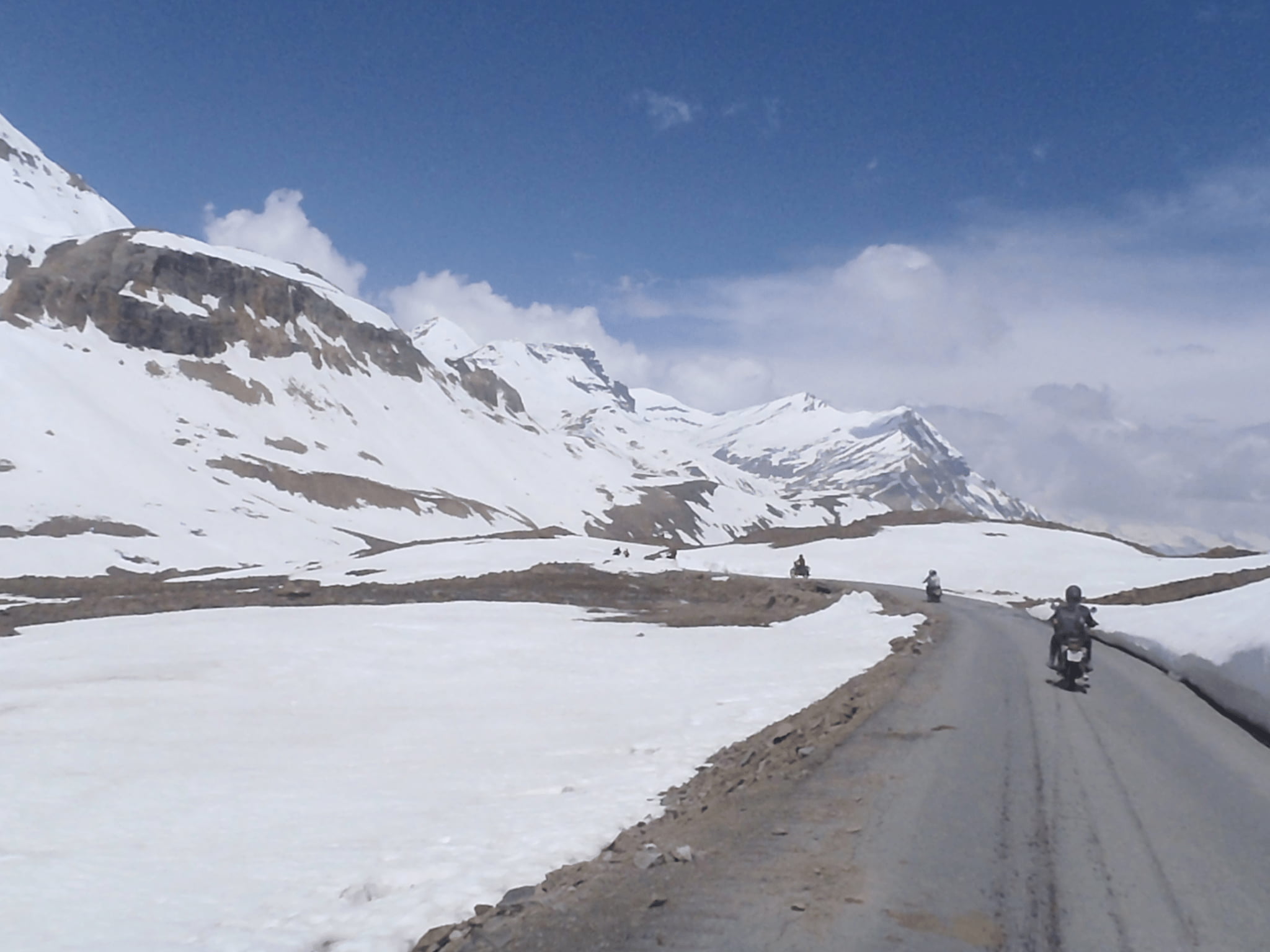
The cyclist may be travelling at a different pace, but the physiological environment is identical. At altitude, reduced oxygen availability can affect exercise capacity, sleep, recovery, appetite, hydration, headache susceptibility, coordination and perceived effort.
Fitness does not make anyone immune to altitude illness. CDC guidance specifically notes that physical fitness does not determine susceptibility to acute mountain sickness, and that the rate of ascent and sleeping altitude are the important factors. Acclimatisation is therefore not an optional extra on a properly planned high-altitude expedition.
Why acclimatisation matters more than speed
A common mistake is to compare two expeditions by asking how quickly you can get to Leh. For high-altitude travel that is usually the wrong question. The better one is: how does the itinerary allow the body to adapt?
CDC guidance recommends gradual ascent and, above 3,000 metres, generally limiting increases in sleeping altitude to about 500 metres per day, with additional acclimatisation time as altitude increases. Individual needs vary. A professionally planned itinerary therefore has to consider where you sleep, how quickly you gain altitude, where rest days fall, how much riding happens at high altitude, what happens if a rider does not acclimatise as expected, and whether there are contingency options. This matters most for international travellers arriving from low-altitude environments.
Which experience gives you more time in the mountains?
That depends on what you mean by time. A motorcycle can take you through a much larger geographical area within the same number of days — ride from one valley to another, cross a pass, visit a monastery and continue towards another destination, all within a single day. A bicycle deliberately slows the journey down. The mountain becomes the activity. A climb is not something you pass through on the way to the destination; the climb is the destination.
Motorcycle expeditions: the geographic experience
A motorcycle is particularly attractive to travellers who want to combine mountain riding, long-distance exploration, remote valleys, Himalayan culture, high passes, lakes, monasteries and multi-region journeys. Because it covers more ground, it becomes possible to connect several different Himalayan regions in a relatively compact expedition.
Our longer itineraries show this clearly. The Himalayan Legends expedition connects Himachal Pradesh, Spiti, Zanskar, Ladakh and Changthang over 20 days, with the published route reaching 5,798 metres at Umling La. That is an expedition where the motorcycle becomes a means of connecting a very large geographical area.
Cycling expeditions: the endurance experience
Cycling creates a different relationship with the landscape. The rider notices every change in gradient and road surface, the wind direction, the temperature, the effort required to gain altitude, small changes in the landscape, and the villages and mountain communities along the route. The physical effort slows the journey down — and for some riders that is exactly the attraction.
Our cycling portfolio includes a 15-day Manali–Zanskar–Leh expedition, a 15-day Manali–Khardung La journey and a 23-day Spiti–Ladakh expedition. These are not simply bicycle holidays. They are multi-day Himalayan endurance journeys.
The routes do not have to be the same
Motorcycle and cycling experiences do not have to follow identical routes, and this matters when choosing your expedition. A motorcycle can cover longer distances and make more extensive loops practical. A cycling expedition has to be designed around sustainable daily riding distances, climbing, recovery, sleeping altitude, support logistics, water and food, and mechanical support. The correct comparison is therefore between experiences and itineraries, not between two lines on a map.
Manali–Zanskar–Leh: where cycling becomes more expedition-oriented
For cyclists looking for something more remote, the Manali–Zanskar–Leh route changes the equation again. Our 15-day Pedal the Himalayas expedition is listed as challenging, reaching approximately 5,363 metres, with around 658 kilometres of cycling on the published itinerary. It travels through Lahaul and Zanskar before continuing towards Ladakh and Leh.
The attraction is not simply reaching Leh. It is travelling through the wider Himalayan landscape: Manali → Lahaul → Zanskar → Ladakh → Leh. For cyclists who want a deeper expedition rather than the most direct crossing, this type of route is particularly compelling.
Manali–Khardung La: a different cycling objective
Our Manali–Khardung La expedition runs 15 days and about 530 kilometres, with a maximum altitude of roughly 5,332 metres. The objective is not simply to arrive in Leh; the journey combines the Manali–Ladakh crossing with the additional challenge of reaching Khardung La. For a cyclist researching Himalayan routes this distinction is important, because a route ending in Leh and a route continuing towards a major high pass need different preparation and expectations.
Spiti–Ladakh: the long-form cycling expedition
At the more demanding end sits the Spiti to Ladakh Cycling Expedition — 23 days, more than 1,200 kilometres of cycling, and a maximum altitude of approximately 5,600 metres. This is a fundamentally different proposition from a shorter Himalayan cycling holiday.
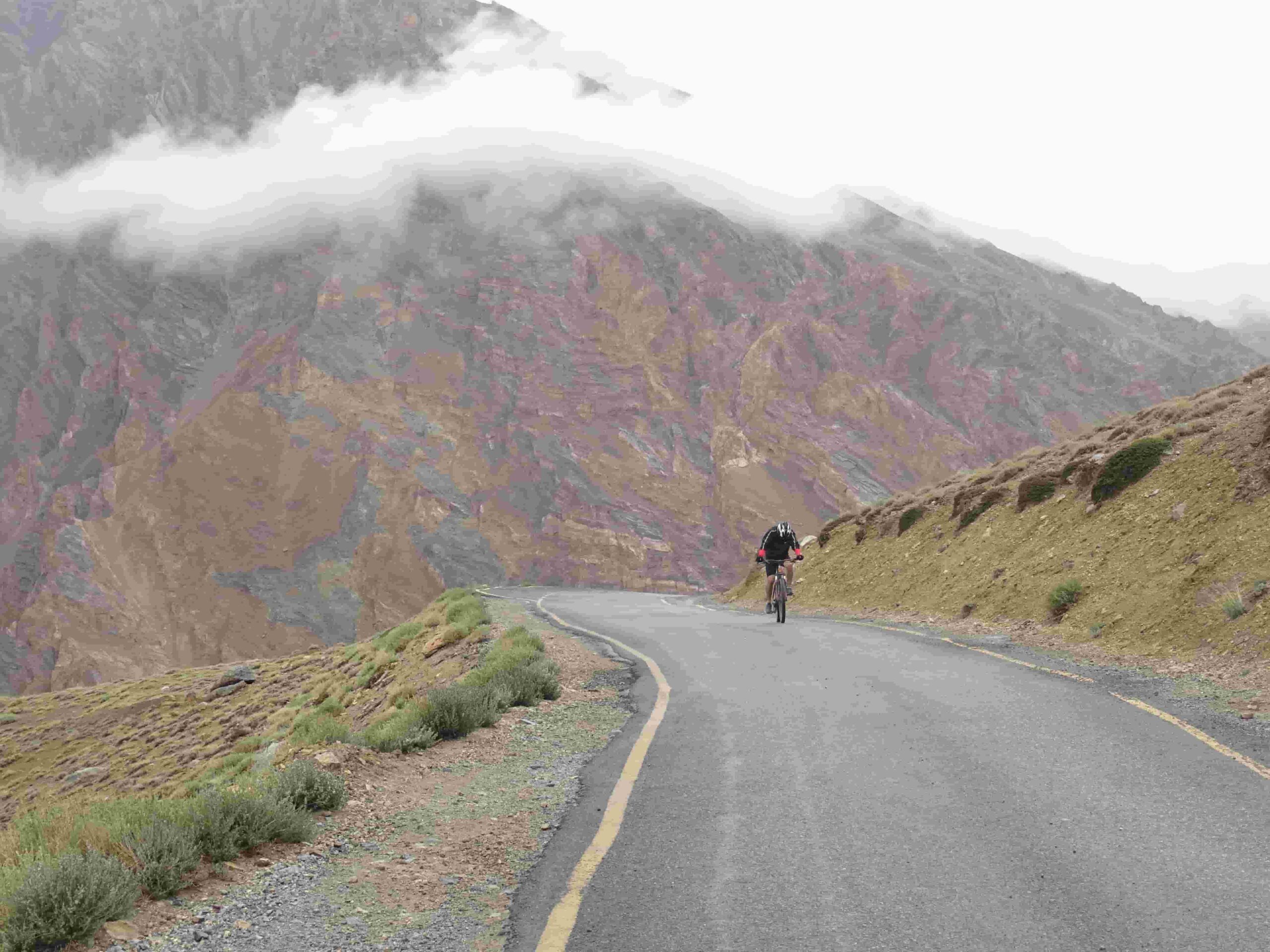
The longer duration means more consecutive riding days, greater accumulated fatigue, more varied terrain, greater geographical coverage, more dependence on expedition logistics, greater importance of recovery and greater need for preparation. For this level of expedition, previous multi-day mountain-cycling experience is far more relevant than being able to complete a long weekend ride. Our guide to Himalayan cycling routes compares all four in more detail.
Preparation
Preparation for the two should be different.
Preparing for a Himalayan motorcycle expedition
A rider should be comfortable with long days on a motorcycle, mountain-road riding, tight bends and switchbacks, loose or uneven surfaces, descending safely, riding in cold weather, basic machine awareness, riding at altitude and maintaining concentration across several consecutive days. Experience on a motorcycle matters far more than simply holding a licence — a rider should be comfortable controlling the machine in conditions very different from normal road riding.
Preparing for a Himalayan cycling expedition
A cyclist should develop cardiovascular endurance, sustained climbing ability, leg and core strength, bike-handling and descending skills, the ability to ride consecutive days, experience on uneven surfaces and cold-weather riding ability. Training should include longer back-to-back rides — being able to ride 100 kilometres once is very different from riding 70–90 kilometres for several consecutive days in the mountains.
What about the bicycle or motorcycle?
Equipment should match the route.
Motorcycle
The machine needs to be mechanically reliable, properly serviced, suitable for mountain roads, comfortable for long riding days and supported by appropriate spares and mechanical expertise. On a professionally supported expedition our published package includes a Royal Enfield motorcycle, a motorcycle mechanic, a road captain and 4×4 backup support, with the exact model and support arrangement depending on the itinerary.
Bicycle
A Himalayan cycling bike needs appropriate gearing, reliable brakes, suitable tyres, strong wheels, correct bike fit, a reliable drivetrain and spare parts appropriate to the route. For remote expeditions mechanical support matters particularly, because a minor mechanical problem can otherwise become a major logistical one. Our cycling expeditions include mountain-bike equipment and mechanical support.
Why support logistics matter
On a normal road trip a mechanical failure is inconvenient. On a remote Himalayan expedition it can affect the entire day’s operation. Depending on the itinerary, serious expeditions use support vehicles, mechanics, luggage transport, spare parts, first-aid equipment, oxygen, communication equipment, route and weather monitoring, and emergency coordination.
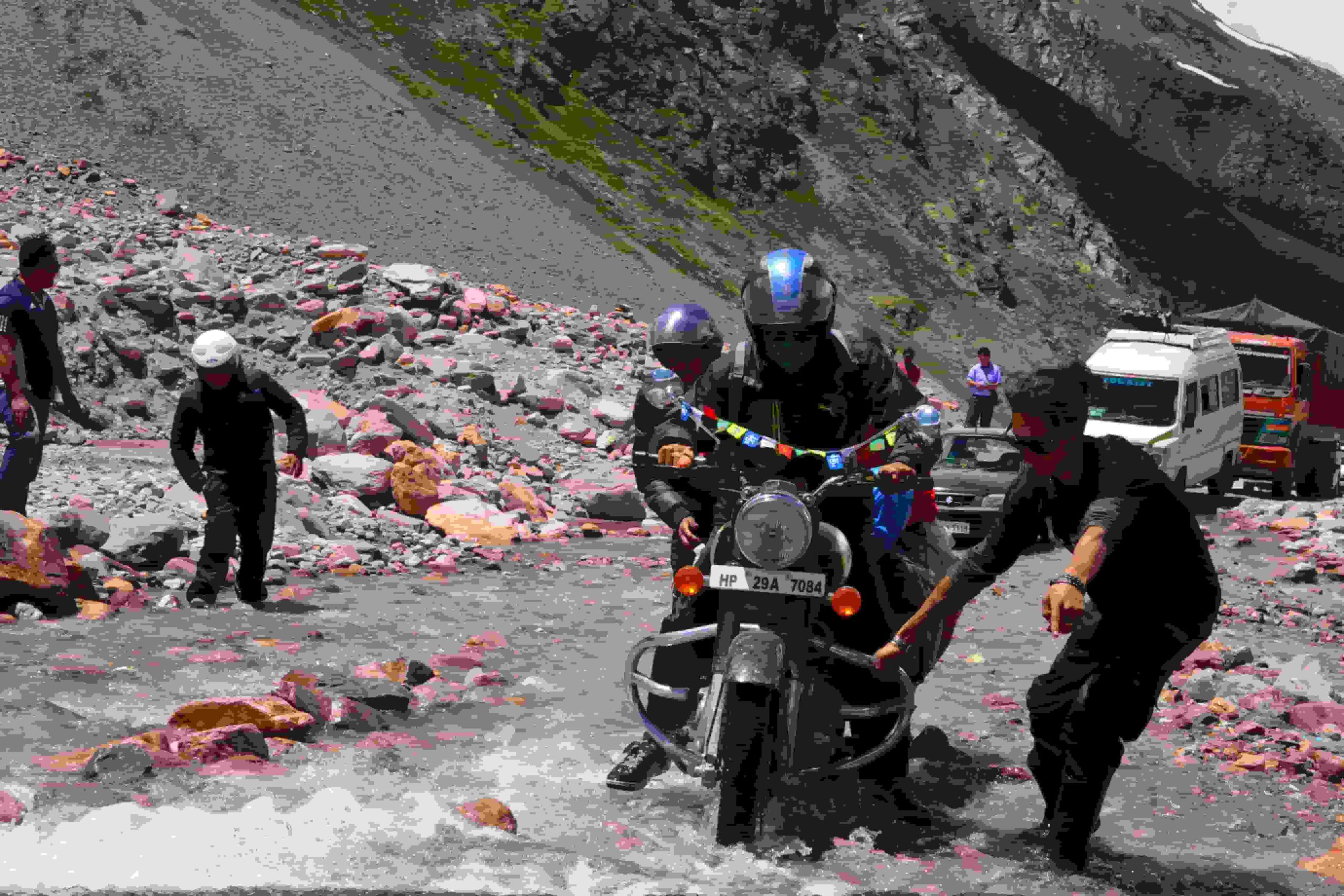
Our motorcycle expeditions use road leadership, mechanics and 4×4 support, while the cycling products use support vehicles and cycling-specific mechanical assistance. The precise support package should always be checked against the specific departure and itinerary.
Which is more adventurous?
This is where a simple ranking becomes misleading. Motorcycle adventure and cycling adventure are different experiences. A motorcycle expedition gives you greater geographical range, remote exploration, mountain riding and cultural travel. A cycling expedition gives you greater physical involvement, endurance, slower mountain travel and direct interaction with the terrain. Neither needs to be described as the better adventure. The right choice depends on what you want the expedition to demand from you.
Which should you choose?
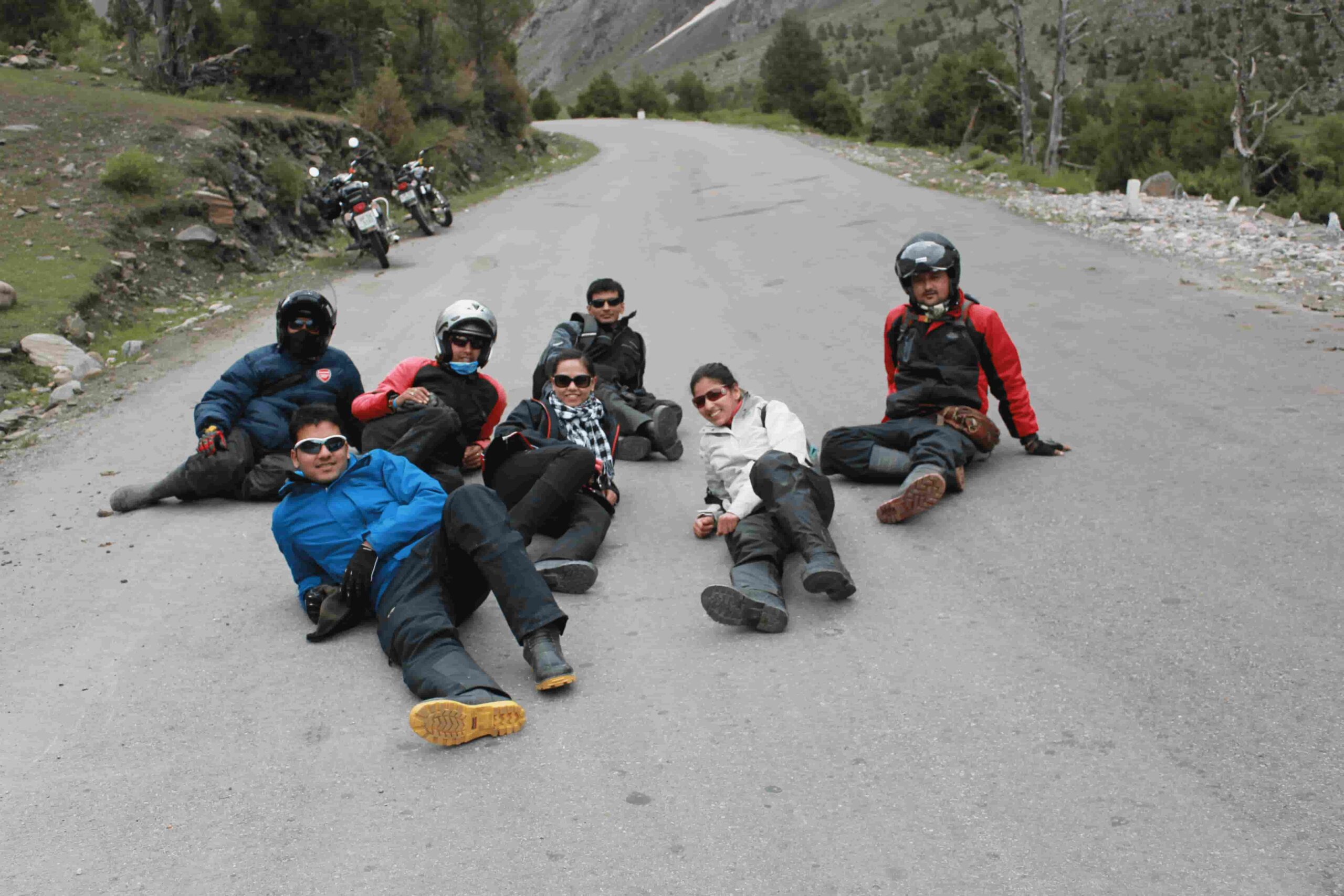
A motorcycle expedition may suit you if you want to
- Explore large areas of the Himalayas
- Ride a Royal Enfield or similar expedition motorcycle
- Cover substantial distances
- Visit several regions during one journey
- Combine riding with cultural exploration
- Experience high mountain passes without cycling the entire elevation yourself
- Make the motorcycle itself part of the adventure
A cycling expedition may suit you if you want to
- Make the physical journey itself the challenge
- Spend more time riding through each landscape
- Test your endurance
- Climb Himalayan passes under your own power
- Experience the mountains at a slower pace
- Combine endurance cycling with cultural exploration
- Challenge yourself over multiple consecutive days
What if you want both?
Some experienced adventure travellers do not have to choose. You could experience one Himalayan region by motorcycle and another by bicycle — a motorcycle expedition through Manali, Spiti and Ladakh, and a cycling expedition through Manali, Zanskar and Leh. The geographical connection creates an interesting opportunity to experience the Himalayas from two completely different perspectives. For an adventure traveller who spends significant time in India, this becomes a progression rather than a choice between two activities.
A practical decision table
| If your priority is… | Consider |
|---|---|
| Long-distance Himalayan exploration | Motorcycle |
| Physical endurance | Cycling |
| Covering more regions in fewer days | Motorcycle |
| Making climbing the central challenge | Cycling |
| Remote mountain riding | Motorcycle |
| A multi-day endurance challenge | Cycling |
| Cultural exploration across a large area | Motorcycle |
| Slower immersion in the landscape | Cycling |
| The motorcycle adventure itself | Motorcycle |
| A high-altitude cycling achievement | Cycling |
This is not a difficulty ranking. It is simply a way of matching the experience with the traveller.
The most important question is not “which is harder?”
When researching the Manali–Leh journey, people often ask whether it is harder by motorcycle or bicycle. A more useful question is: what do I want the mountain to ask of me?
If you want the motorcycle to be part of the challenge and the journey to cover a large geographical area, a motorcycle expedition makes more sense. If you want your own physical effort to define the journey, cycling is the better match. If you want remote Himalayan exploration combined with endurance, routes such as Manali–Zanskar–Leh or Spiti–Ladakh take the cycling experience further. The choice should be based on experience, preparation, time, route and personal objectives, rather than a simple label of easy or difficult.
The Himalayas are experienced differently from two wheels
A motorcycle and a bicycle can take you into the same broad Himalayan region, but they create very different relationships with the mountains. The motorcycle lets you connect distant valleys, high passes and cultural landscapes within a relatively compact expedition. The bicycle slows the journey down and makes every climb, descent and kilometre part of the experience.
That is the real distinction. Motorcycle expeditions are about riding through the Himalayas. Cycling expeditions are about physically travelling through the Himalayas under your own power. For international travellers, the right choice is not the one with the lower or higher difficulty — it is the route and activity that best matches your experience, preparation, available time and the kind of mountain journey you want to undertake.
Into Wild Himalaya Expeditions operates both professionally supported motorcycle and cycling journeys across the Indian Himalayas, including routes through Himachal Pradesh, Zanskar, Spiti and Ladakh.
Explore the routes, understand the demands and choose the Himalayan experience that matches your ambition — or talk to our team about dates and route choice.
Frequently asked questions
Is Manali–Leh better by motorcycle or bicycle?
They are different experiences rather than interchangeable versions of the same trip. Motorcycle travel allows greater daily distance and geographical range, while cycling makes physical endurance and climbing a much larger part of the experience.
How difficult is Manali–Leh by bicycle?
It is a serious high-altitude cycling undertaking. Difficulty depends on the exact itinerary, elevation gain, road conditions, altitude, weather, daily distance and the rider’s experience.
Is Manali–Leh suitable for a first Himalayan motorcycle trip?
It depends on the rider’s existing motorcycle experience and the exact itinerary. Basic confidence on a motorcycle is not the same as experience on high-altitude mountain roads.
Does cycling fitness protect me from altitude sickness?
No. Fitness and altitude tolerance are not the same thing. CDC guidance states that physical fitness does not determine susceptibility to acute mountain sickness.
How important is acclimatisation?
Extremely important for high-altitude travel. The rate of ascent and sleeping altitude should be considered when planning the itinerary, and travellers should respond to altitude symptoms rather than simply continuing upward.
Do motorcycle riders also need to acclimatise?
Yes. A motorcycle reduces physical cycling effort but does not remove the physiological effects of altitude.
Do I need previous mountain-bike experience for a Himalayan cycling expedition?
For demanding multi-day routes, previous mountain-cycling and endurance experience is strongly relevant. A beginner may be better served by developing mountain-bike skills before attempting a high-altitude expedition.
Which IWH cycling expedition is the most extensive?
The Spiti–Ladakh Cycling Expedition is listed at 23 days and more than 1,200 kilometres, making it the longest of the main Himalayan cycling expeditions currently offered.
Which IWH motorcycle expedition covers the widest Himalayan geography?
The Himalayan Legends itinerary connects Himachal Pradesh, Spiti, Zanskar, Ladakh and Changthang over 20 days.
Can I combine cycling and motorcycle travel in India?
Yes. They can be planned as separate journeys or as part of a longer adventure programme, depending on dates, route access and availability.


