
Snow leopard season in Spiti runs January to March, when prey animals move down to lower slopes and the cats follow them into glassing range. The base is Kibber at 4,270 m, reached via Shimla and Kinnaur because the Manali road is shut. Temperatures reach minus 25°C. Our expedition runs 15 days.
Winter in Spiti is one of the hardest trips India offers and one of the few where the reward isn’t a view. It’s an animal that may not appear. People spend two weeks at 4,000 m in temperatures that freeze camera batteries, staring through a spotting scope at a brown hillside, for a chance at one encounter.
Those who get it talk about it for the rest of their lives. Those who don’t, quite often come back. This explains why.

Why Winter Is the Only Season for This
Snow leopards live in Spiti all year. You cannot realistically see one in summer, and the reason is simple.
In the warm months, blue sheep and ibex graze high, often above 5,000 m, spread across a vast area of broken ground. The cats follow the prey, which means they’re up there too, in terrain you cannot cover on foot and cannot see into from a road.
When the snow comes, that high grazing disappears. The prey animals move down the slopes towards the villages and the valley floors, concentrating in a much smaller band of ground. The snow leopards come down after them.
That’s the whole season in one sentence. Winter doesn’t make the cats more numerous. It makes them visible, by bringing them into country you can actually watch from a fixed position with optics.
Snow on the ground helps twice over. A grey cat on grey scree is close to invisible, and the same cat on snow is not. Tracks also tell you where it went, which is most of how a day’s search begins.
What Tracking Actually Looks Like
This is the part worth being blunt about, because the marketing imagery suggests something it isn’t.
You are not stalking an animal through snow. You are sitting still, in the cold, for a long time, while experienced local spotters work the slopes through scopes and binoculars. The technique is called glassing and it is methodical, patient and almost entirely stationary.
A typical day runs something like this. Out before first light, because dawn and dusk are when the cats move. Drive or walk to a vantage point overlooking known habitat. Set up scopes. Then search, systematically, slope by slope, for hours. Lunch happens where you are. If a spotter finds something, the whole group moves to it. If nothing appears, you shift to another vantage point in the afternoon and do it again until the light goes.
The spotters are the entire product. They’re local men, usually from Kibber or the surrounding villages, who have grown up reading these slopes and who find in ten minutes what a visitor would never find at all. A good expedition is defined by the quality of its spotters and the number of them working, and by nothing else. Not the vehicles, not the hotel.
You’ll also spend a lot of time looking at tracks, scrapes, scent marks and kills. Learning to read that is a large part of what the trip teaches you, and it’s genuinely interesting even on days when nothing is seen.
The Season, Month by Month
| Period | Conditions |
|---|---|
| November to December | Cold arriving, snow building, prey beginning to move down. Possible but early |
| January | Deep cold, good snow, strong conditions. The hardest month to endure |
| February | Generally regarded as the peak. Snow established, prey low, long enough daylight to work with |
| March | Still strong, slightly warmer, light improving. Snow begins retreating late in the month |
| April to October | Not viable. The prey is high, the cats are high, and the ground cannot be watched |
February is where we put our departures, and our expedition runs from 1 February. It’s the best compromise between snow cover low enough to concentrate the animals and daylight long enough to spend a useful number of hours searching.
January is colder and arguably has marginally better snow. Whether that trade is worth it depends on your tolerance for genuine cold, which most people overestimate before they’ve experienced it.
Getting In: Why You Go Via Shimla, Not Manali
Spiti has two road approaches and in winter only one of them exists.
The Manali to Kaza road crosses Kunzum La and is shut by snow for roughly six to seven months, broadly November through May. It normally reopens between late May and early June once the Border Roads Organisation clears the pass. In February it is not an option, and no amount of planning changes that.
The Shimla to Kaza route through Kinnaur stays open year round. It follows the Sutlej and then the Spiti river, it’s long, and it climbs gradually.
Our itinerary uses it deliberately: Chandigarh, then Narkanda, Kalpa in Kinnaur, Tabo, and then Kaza. That’s four days of driving to cover ground a map suggests should take two.
The slow approach is the single most important design decision on a winter Spiti trip, and it isn’t about scenery. It’s acclimatisation, covered below.
| Manali to Kaza | Shimla to Kaza via Kinnaur | |
|---|---|---|
| Winter status | Closed, roughly November to May | Open year round |
| Pass crossed | Kunzum La | None above the route’s own altitude |
| Approach profile | Fast and abrupt | Gradual over several days |
| Use in snow leopard season | Not possible | The only route |
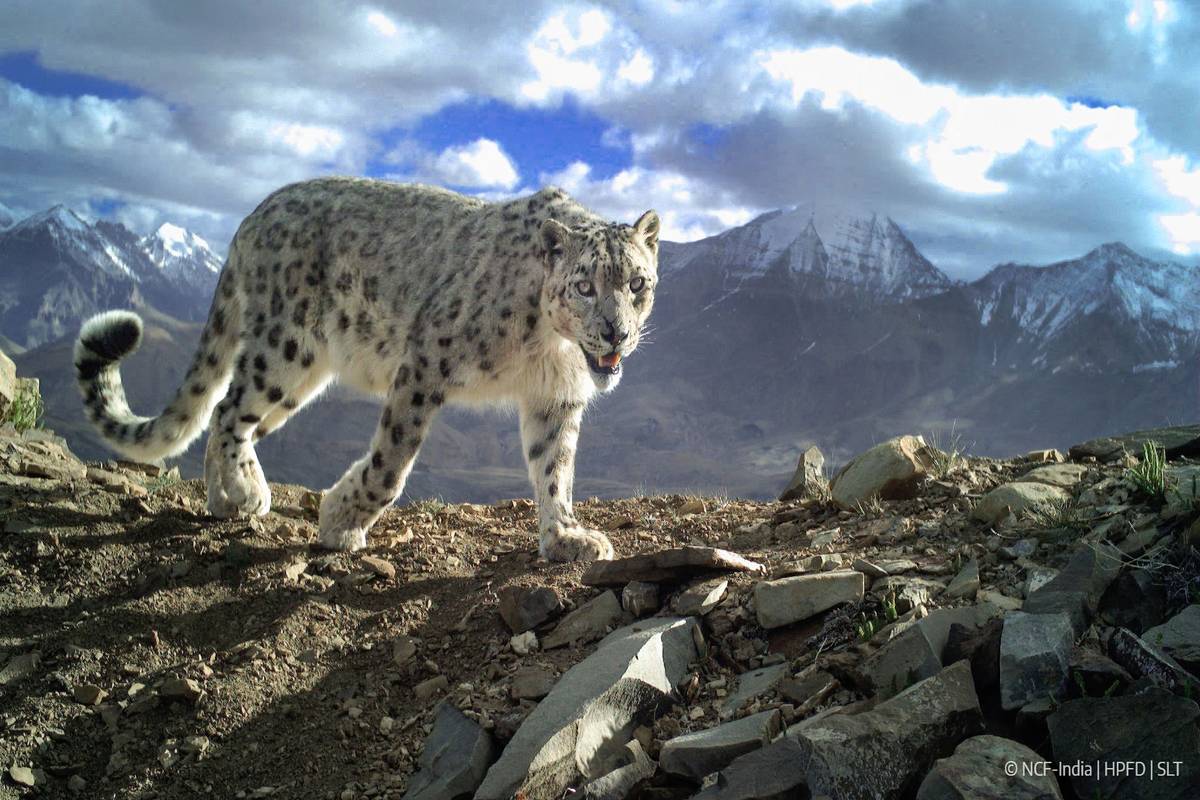
The Cold, Honestly
Numbers are more useful here than adjectives.
| Typical winter range | |
|---|---|
| Kibber, night | Around minus 20°C to minus 25°C |
| Kibber, day in sun | Around minus 5°C to minus 10°C |
| Wind chill on an exposed vantage point | Considerably below the air temperature |
What that actually means in practice:
Standing still is the problem, not walking. Glassing generates no body heat. You will be colder sitting at a vantage point in minus 10°C than walking uphill in minus 20°C. Insulation has to be built for stationary waiting, which means more of it than a trekking kit.
Camera batteries die. Keep spares inside your jacket against your body and rotate them. A battery at minus 20°C may show empty and then recover once warmed.
Water freezes. Insulated flasks, not bottles, and keep them inside a pack rather than strapped to the outside.
Extremities are where it goes wrong. Two pairs of gloves, a thin liner you can shoot in and a heavy mitt over the top. Boots a size large to allow thick socks without compression. Toe and hand warmers are worth their weight many times over.
Accommodation is basic and heated locally. Village homestays and guest houses in Kibber and Kaza are not insulated to the standard of a European winter hotel. Heating is usually a bukhari stove. It’s warm when lit and cold at four in the morning.
Nobody arrives having packed too much warm clothing.
Altitude: The Part People Underestimate
Kaza sits at about 3,800 m. Kibber, where the searching happens, is at 4,270 m. Our itinerary tops out around 4,800 m on the high ridges.
Those are serious altitudes to be sleeping at, let alone sleeping at for a week in deep cold while getting up before dawn every day.
Guidance from the CDC is unambiguous that fitness does not determine who develops acute mountain sickness. Rate of ascent and sleeping altitude are the controlling factors. This is why our itinerary spends four days reaching Kaza, has an explicit acclimatisation phase there, and only then moves up to Kibber.
Any winter Spiti trip that gets you to Kibber in two or three days from the plains is taking a risk with your health and with the trip. At minus 20°C, at 4,270 m, a case of altitude sickness is not a minor inconvenience. Evacuation means a long drive on winter roads.
The cold makes altitude worse, too. Dehydration is faster than people expect because the air is extremely dry and you don’t feel thirsty. Drinking enough when everything is frozen takes active effort.
Where You Actually Look
Kibber is the base and the surrounding area is where most sightings happen.
Kibber and the slopes above it. The village sits at 4,270 m inside the Kibber Wildlife Sanctuary, which covers roughly 1,400 sq km across an elevation range of 3,600 m to 6,600 m, and is India’s only wildlife sanctuary in a cold desert.
Chicham canyon. About 6 km from Kibber, linked by the Chicham bridge, a suspension truss bridge at 4,137 m spanning 114 m across the Samba Lamba gorge, completed in 2017. The gorge walls are prime habitat and the bridge gives access to vantage points that were a long detour before it existed.
Langza and the fossil valley. Higher, more open, with marine fossils in the ground from when this was the floor of the Tethys sea. Good for blue sheep and for wolf.
Hikkim and the high ridges. The highest ground on the itinerary and the coldest place to sit still.
Our expedition gives each of these its own field day, plus a reserve habitat day and a final field day, which is the honest way to build a wildlife itinerary. You cannot schedule an animal. You can only buy more days of looking.

What Else You’ll See
A snow leopard is the reason people come and it is not the only thing there.
| Species | Likelihood |
|---|---|
| Blue sheep (bharal) | Near certain, often in large herds |
| Himalayan ibex | Very likely |
| Red fox | Likely |
| Himalayan griffon and golden eagle | Likely |
| Tibetan wolf | Possible, and a genuinely rare sighting |
| Himalayan lynx | Uncommon |
| Snow leopard | The reason you’re here. See below |
Tibetan wild ass occurs in the wider cold desert region. Himachal Pradesh’s snow leopard population was assessed at 51 in 2021 and 83 in 2025, which is a meaningful increase and reflects better survey coverage as much as population growth.
Will You See One?
The honest answer: probably, on a well run expedition with enough days and good spotters, but there is no guarantee and anyone offering one is lying to you.
Treat quoted success percentages with suspicion. Nobody is running controlled trials on this, and the figures that circulate are marketing. What genuinely moves the odds:
- Number of field days. The single biggest factor. Three days is a lottery. Six is a reasonable expedition. Our itinerary has six dedicated field days plus a reserve day.
- Quality and number of spotters. More experienced eyes on more slopes.
- Small group size. Six people can move quietly to a sighting. Twenty cannot. Ours is capped at 6.
- Snow conditions that year. Outside anyone’s control. A low snow winter keeps the prey higher and the whole season is harder.
- Your own patience. The people who see snow leopards are disproportionately the ones still at the scope at the end of the afternoon.
Go for the expedition rather than the tick. Spiti in winter is extraordinary whether or not a cat appears, and people who arrive treating a sighting as the only acceptable outcome tend to have a bad two weeks.
Spiti or Ladakh?
We run both and they’re different trips.
| Spiti, Kibber | Ladakh, Hemis National Park | |
|---|---|---|
| Duration | 15 days | 10 days |
| Highest point | 4,800 m | 4,250 m |
| Access | Road from Shimla, four days | Flight to Leh |
| Maximum group | 6 | 6 |
| Departure | 1 February | 15 February |
| Price | ₹275,000 | ₹380,000 |
| Character | Longer, remoter, gradual acclimatisation by road | Shorter, more comfortable, flight access |
| Trade off | Time on the road, better acclimatisation | Less travel, abrupt altitude gain on arrival |
Choose Spiti if you have the time and want the fuller expedition. Choose Ladakh if your leave is limited, and build in extra days in Leh before the expedition starts to deal with the altitude that a flight hands you all at once.
Photography Kit
Briefly, because the detail belongs in a conversation.
Snow leopards are usually seen at genuine distance. A 500 mm or 600 mm lens is the working range, and a 1.4x converter earns its place. A sturdy tripod with a gimbal head matters more than most people expect, since you may be tracking an animal at extreme focal length for several minutes.
Bring far more batteries than you think, keep them warm, and expect to shoot at higher ISO than you’d like because the best activity is in the worst light. Snow fools metering, so know how your camera handles exposure compensation before you arrive rather than learning it on the slope.
Booking a Winter Spiti Expedition
Into Wild Himalaya Expeditions has operated in the Indian Himalayas since 2004.
The Spiti Snow Leopard Photography Expedition runs 15 days with a maximum group size of 6, graded Moderate, reaching 4,800 m, at ₹275,000 per person, departing 1 February. It enters via Shimla and Kinnaur with acclimatisation built in, and dedicates six days to field searching plus a reserve day.
The Ladakh Snow Leopard Expedition runs 10 days in Hemis National Park, maximum 6, reaching 4,250 m, at ₹380,000 per person, departing 15 February.
Talk to our team about which suits your time, your tolerance for cold and your photography goals. And read our season by season packing guide before you start buying kit, because a winter Spiti list is not a trekking list.
If Ladakh’s other season interests you, our guide to the Hemis Festival covers the summer monastic calendar in the same region.
Frequently Asked Questions
When Is Snow Leopard Season in Spiti?
January to March, with February generally regarded as the peak. In winter the blue sheep and ibex that snow leopards hunt move down from high summer grazing to lower slopes near the villages, and the cats follow them into ground that can be watched through scopes. Outside those months sightings are not realistic.
Why Can You Only See Snow Leopards in Winter?
Because in summer both the cats and their prey are above 5,000 m across a huge area of broken terrain that cannot be covered on foot or watched from a road. Snow removes the high grazing, pushes the prey down, and brings the leopards into a narrow band of visible ground. Snow cover also makes a grey cat visible and leaves tracks to follow.
What Is the Altitude of Kibber?
Kibber sits at 4,270 m, about 14,010 ft, roughly 18 to 20 km from Kaza by road. Kaza itself is at around 3,800 m. Kibber is inside the Kibber Wildlife Sanctuary, which spans about 1,400 sq km across elevations from 3,600 m to 6,600 m.
How Cold Does Spiti Get in Winter?
Nights in Kibber commonly reach minus 20°C to minus 25°C, with daytime in sun around minus 5°C to minus 10°C and wind chill well below that on exposed vantage points. Because tracking means sitting still for hours, the insulation you need is heavier than a trekking kit.
Can You Reach Spiti in Winter From Manali?
No. The Manali to Kaza road crosses Kunzum La and is closed by snow for roughly six to seven months, broadly November to May, reopening between late May and early June. Winter access is via Shimla and Kinnaur, which stays open year round.
Are You Guaranteed to See a Snow Leopard?
No, and any operator guaranteeing it is not being straight with you. What improves the odds is the number of dedicated field days, the quality and number of local spotters, a small group, and that winter’s snow conditions. Quoted success percentages are marketing rather than data.
How Many Days Do You Need for a Snow Leopard Expedition?
Allow at least six dedicated field days, plus the travel and acclimatisation either side. Our Spiti expedition runs 15 days in total with six field days and a reserve day. Three day attempts are a lottery, because you cannot schedule a wild animal and the only lever you control is time spent looking.
What Other Wildlife Can You See in Spiti in Winter?
Blue sheep in large herds are close to certain, Himalayan ibex very likely, and red fox, Himalayan griffon and golden eagle all common. Tibetan wolf and Himalayan lynx are possible but rare. Himachal Pradesh’s snow leopard population was assessed at 83 in 2025, up from 51 in 2021.
Is a Winter Spiti Trip Physically Hard?
It’s hard on endurance rather than fitness. There’s no technical trekking, but you’re sleeping above 3,800 m, rising before dawn, and sitting still in extreme cold for hours. Altitude matters more than conditioning, which is why a gradual road approach and a proper acclimatisation phase are built into the itinerary.
What Camera Equipment Do You Need for Snow Leopard Photography?
Sightings are usually at real distance, so a 500 mm or 600 mm lens is the working range, with a 1.4x converter useful. Bring a sturdy tripod with a gimbal head and far more batteries than you expect, kept warm against your body, because cells drain fast below minus 20°C.


