
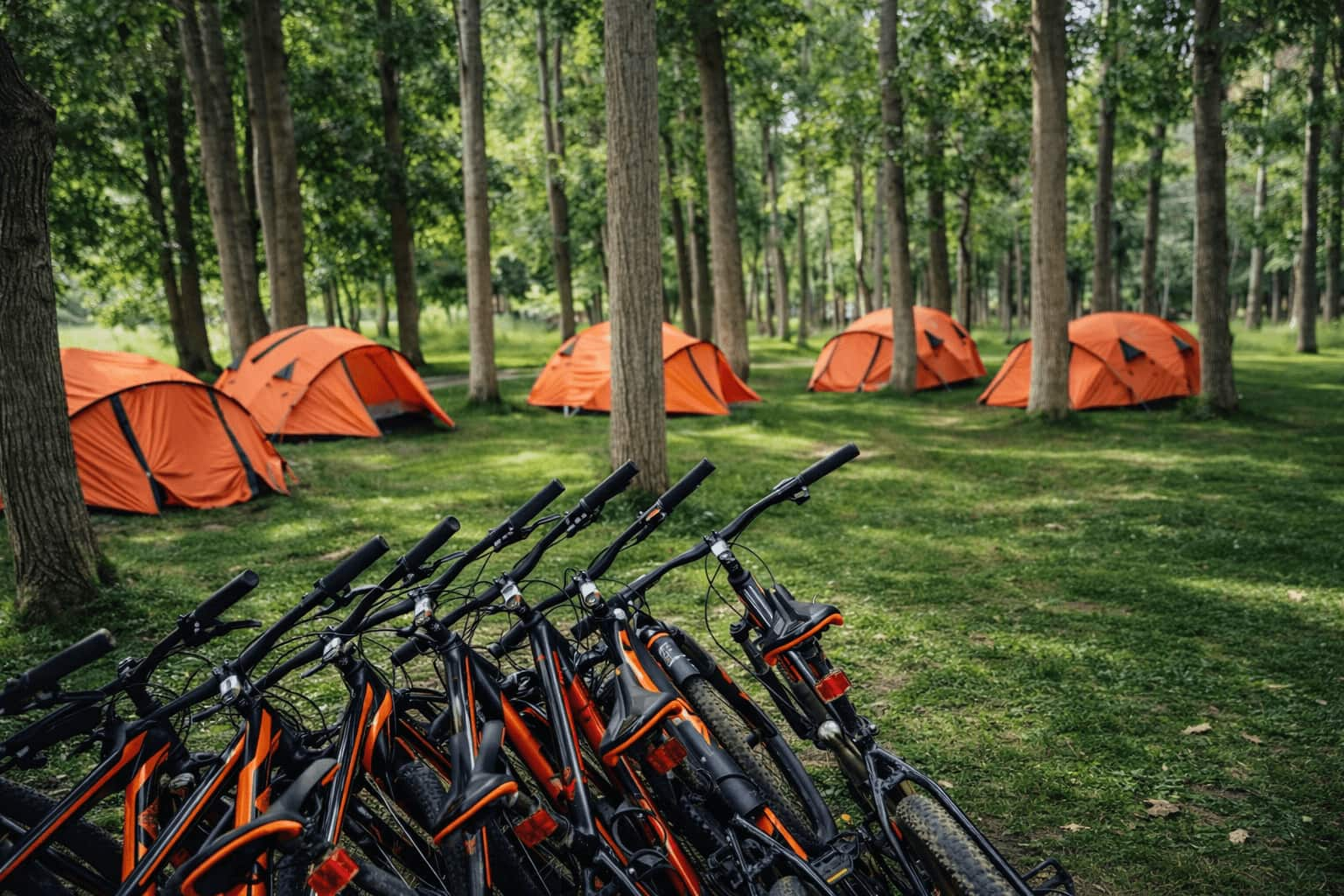
Cycling in the Himalayas is not one single type of adventure. A rider looking for a high-altitude cycling expedition in India can choose between established mountain roads, remote Trans-Himalayan valleys, demanding high passes and long expedition routes connecting several Himalayan regions.
The most famous route is the Manali–Leh Highway, but it is only one part of the Himalayan cycling experience. Routes through Zanskar and Spiti offer a very different combination of terrain, remoteness and cultural landscapes, while longer expeditions can connect Himachal Pradesh, Zanskar and Ladakh into one continuous journey.
Choosing the right route therefore requires more than looking at the distance. You need to understand the altitude profile, major passes, road and trail conditions, daily riding distances, acclimatisation requirements, season, remoteness, support system and your own cycling experience.
This guide explains the major Himalayan cycling routes in India and how to choose between them.
What Makes Himalayan Cycling Different?
Cycling in the Himalayas is fundamentally different from a conventional road cycling holiday. The challenge is not simply climbing hills. At high altitude, riders are dealing with thinner air, large elevation changes, rapidly changing weather, cold temperatures, remote roads and long distances between established services.
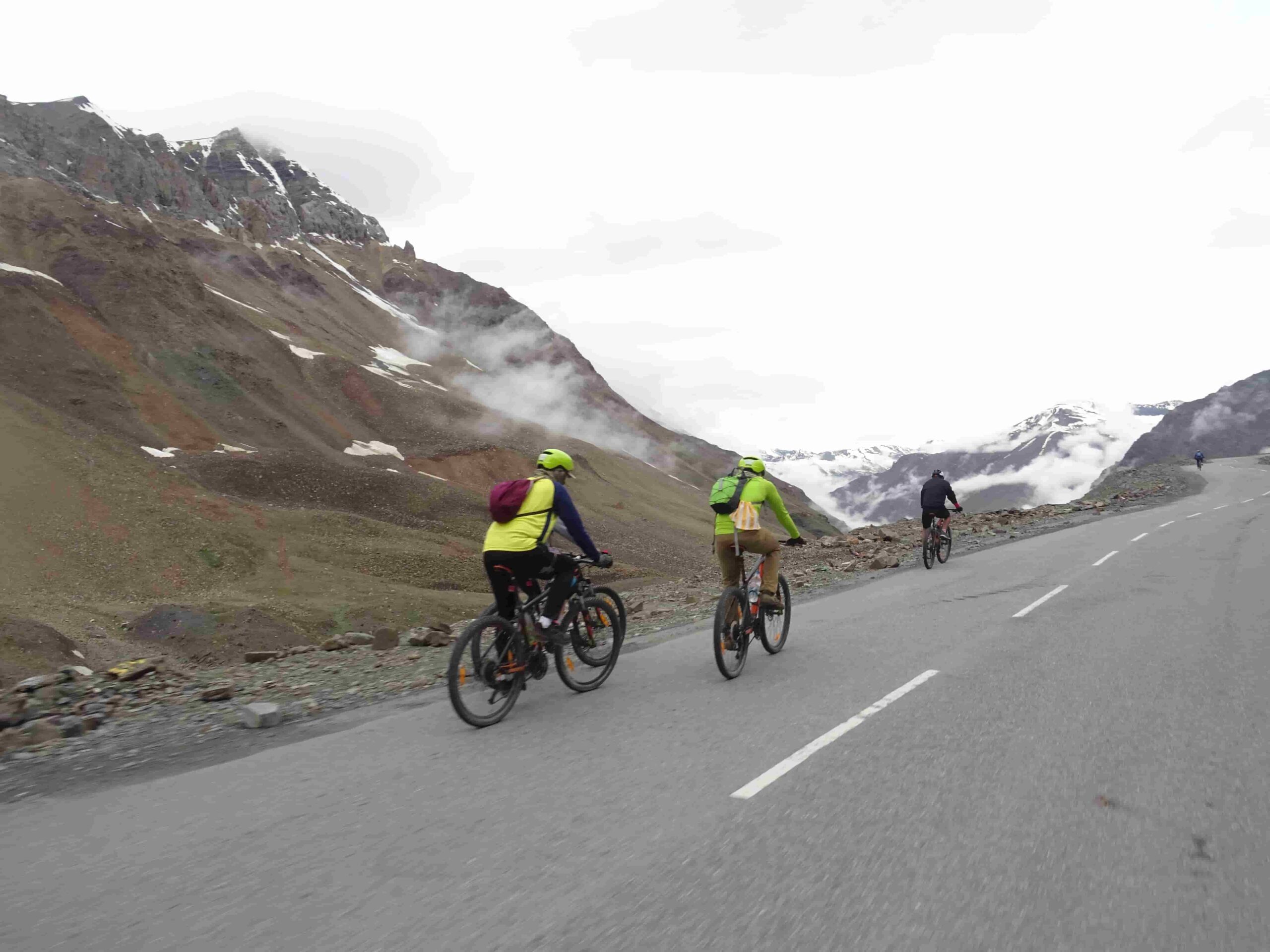
A route may begin in a green Himalayan valley surrounded by forests and orchards and, within a few days, transition into a landscape dominated by enormous mountain passes, barren plateaus and high-altitude valleys. This dramatic geographical change is one of the reasons Himalayan cycling attracts experienced cyclists from around the world.
But it also means that route selection matters. A cyclist who is comfortable completing 100 kilometres at low altitude may still find a much shorter Himalayan stage demanding when it includes a long climb above 4,000 or 5,000 metres. For this reason, Himalayan cycling should be approached as a combination of endurance cycling, mountain travel and altitude management.
The Main Himalayan Cycling Routes in India
For international cyclists researching India, four route concepts are particularly important: Manali–Leh, Manali–Zanskar–Leh, Manali–Khardung La and Spiti–Ladakh. These are not simply four versions of the same trip. Each has a different character.
| Route | Main character | Altitude | Terrain | Experience |
|---|---|---|---|---|
| Manali–Leh | Classic Himalayan high-altitude road journey | Very high | Mountain roads, passes | Experienced cyclists |
| Manali–Zanskar–Leh | Remote multi-region expedition | Very high | Roads, gravel, high passes | Strong, experienced cyclists |
| Manali–Khardung La | Long high-altitude challenge ending at Khardung La | Very high | Mountain roads, major passes | Experienced cyclists |
| Spiti–Ladakh | Longest and most demanding expedition | Extreme | High passes, remote roads, mixed terrain | Strong, experienced cyclists |
The important point is that route difficulty cannot be judged from distance alone.
1. Manali to Leh Cycling Route
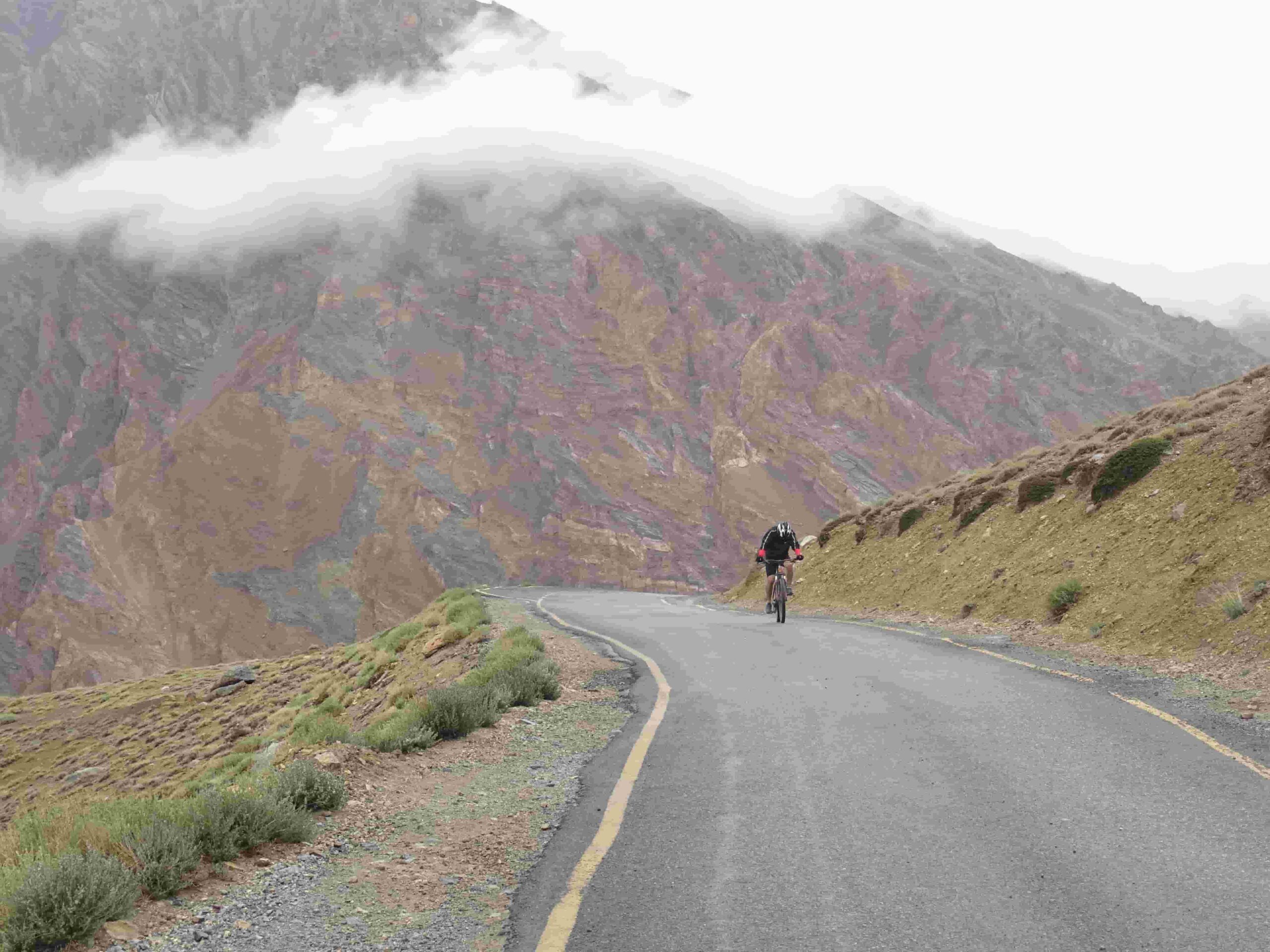
The Manali–Leh route is one of the best-known high-altitude cycling journeys in the Indian Himalayas. The route connects the green mountain environment around Manali with the high-altitude desert landscapes of Ladakh. Cyclists gradually leave the forests and valleys of Himachal Pradesh and enter a landscape dominated by enormous mountain passes, remote camps and high-altitude valleys.
The established Manali–Leh corridor is around 475–500 kilometres depending on the exact route and side sections, with the route reaching above 5,000 metres. Current route references describe it as a hard high-altitude cycling journey rather than simply a long-distance ride.
What are the major passes?
Depending on the exact route and current road configuration, cyclists encounter major high-altitude passes including:
- Baralacha La
- Nakee La
- Lachulung La
- Tanglang La
Historically, Rohtang La was another major part of the route; current road access through the Atal Tunnel changes how the lower section is approached. The major challenge is not simply reaching one pass. It is the cumulative effect of repeatedly climbing and descending at high altitude.
Why do cyclists choose Manali–Leh?
The route combines:
- A famous Himalayan cycling corridor
- Multiple high mountain passes
- Dramatic changes in landscape
- Lahaul and Ladakh
- High-altitude desert
- Remote mountain camps
- Long mountain climbs
- A strong sense of progression from Manali to Leh
For cyclists who want their first major Himalayan expedition, the route is an obvious one to investigate. However, riders should not confuse its fame with simplicity. The route remains a serious high-altitude cycling undertaking.
2. Manali to Zanskar to Leh Cycling Route
For riders looking for something more remote and expedition-oriented, the Manali–Zanskar–Leh route offers a very different experience.
Our Pedal the Himalayas: Manali–Zanskar–Leh Cycling Tour currently runs for 15 days and is listed as challenging, with a maximum altitude of 5,363 metres. The published itinerary includes Shinkun La at around 5,040 metres, remote Zanskar villages, Phuktal Monastery, Lingshed, Singe La and the final ascent towards Khardung La.
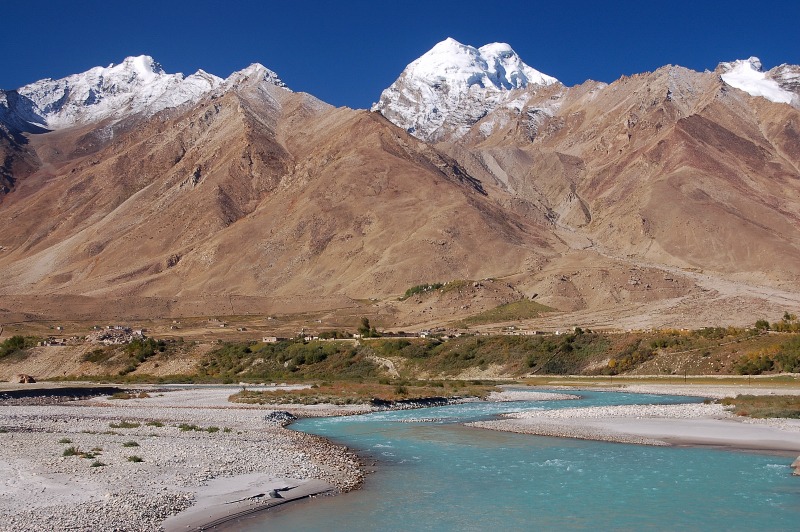
This route is important because it does not simply take the traditional Manali–Leh corridor. Instead, it connects Manali → Lahaul → Zanskar → Ladakh → Leh. That creates a much more varied expedition.
Why is Zanskar different?
Zanskar is one of the defining attractions of this route. The landscape becomes more remote and the cycling experience becomes less about following a famous highway and more about travelling through isolated mountain valleys and settlements. The itinerary includes:
- Shinkun La
- Kurgiakh
- Phuktal Monastery
- Padum
- Zangla
- Lingshed
- Singe La
- Photoksar
- Lamayuru
- Leh
- Khardung La
The route currently lists approximately 658 kilometres of cycling, although daily riding distances vary substantially across the itinerary. For international cyclists, this is an important distinction: Manali–Leh is the classic route, while Manali–Zanskar–Leh is the deeper expedition.
3. Manali to Khardung La Cycling Route
Another route option is to start in Manali and continue all the way towards Khardung La. Our Manali to Khardung La Cycling Tour is currently listed as a 15-day, difficult high-altitude expedition covering about 530 kilometres, with a maximum altitude of approximately 5,332 metres. The route crosses major passes including Rohtang La, Baralacha La, Nakee La, Lachulung La and Tanglang La before continuing towards Leh and Khardung La.
This is particularly attractive to cyclists who are researching high-altitude cycling, Khardung La cycling, Manali to Ladakh cycling, Himalayan cycling challenges and long-distance cycling in India.
The route combines the classic Manali–Leh corridor with the additional objective of reaching Khardung La. That changes the character of the journey. You are not simply travelling to Leh. You are continuing towards a major high-altitude objective after already completing a demanding Himalayan crossing.
4. Spiti to Ladakh Cycling Expedition
At the more demanding end of the spectrum is the Spiti–Ladakh route. Our Spiti to Ladakh Cycling Expedition is currently listed at 23 days, with more than 1,200 kilometres of cycling and a maximum altitude of approximately 5,600 metres. The expedition travels through Spiti before continuing across the high mountain landscapes towards Ladakh.
This is not a short cycling holiday. It is an expedition designed for strong and experienced cyclists. The route includes major Himalayan landscapes and passes associated with:
- Spiti Valley
- Kunzum La
- Baralacha La
- Nakee La
- Taglang La
- Tso Kar
- Ladakh
- Khardung La
The attraction is the scale. Instead of experiencing one Himalayan region, riders move through several distinct mountain environments over an extended period.
Which Himalayan Cycling Route Is Right for You?
This is one of the most important questions to answer before booking. There is no single best Himalayan cycling route for every rider. Instead, consider what kind of experience you are looking for.
Choose Manali–Leh if you want:
- A classic Himalayan cycling route
- The famous Manali–Leh crossing
- Multiple high mountain passes
- A relatively direct route between Himachal Pradesh and Ladakh
- A first major high-altitude cycling expedition
Choose Manali–Zanskar–Leh if you want:
- A more remote experience
- Zanskar Valley
- High-altitude passes
- Buddhist villages and monasteries
- Less conventional Himalayan cycling
- A multi-region expedition
Choose Manali–Khardung La if you want:
- The Manali–Leh experience
- A longer high-altitude challenge
- Khardung La as a specific cycling objective
- Major Himalayan passes
- A demanding expedition with strong logistical support
Choose Spiti–Ladakh if you want:
- A long expedition
- Spiti and Ladakh in one journey
- More than 1,000 kilometres of riding
- Extended exposure to high-altitude terrain
- Multiple mountain passes
- A serious endurance challenge
How Difficult Is Himalayan Cycling?
Difficulty needs to be understood in several dimensions. A route can be difficult because of distance, elevation gain, altitude, terrain, weather or remoteness — and usually because of all of them at once.
- Distance. Long daily stages require sustained endurance.
- Elevation gain. A 60-kilometre day containing several thousand metres of climbing can be much harder than a longer but flatter stage.
- Altitude. This is one of the defining factors of Himalayan cycling. The ability to ride at sea level does not automatically mean you will perform similarly above 4,000 metres.
- Terrain. Depending on the route, cyclists can encounter smooth tarmac, broken mountain roads, gravel, loose surfaces, steep switchbacks, rough sections and wet sections or river crossings depending on conditions.
- Weather. Mountain weather can change rapidly. Cold, wind, rain, snow and sun exposure can all become part of the same expedition.
- Remoteness. Remote sections mean that cyclists cannot always rely on shops, workshops, accommodation or immediate medical infrastructure. This is where expedition support becomes important.
How High Is Too High for Cycling?
There is no single altitude at which cycling suddenly becomes impossible, but altitude changes the physical demands significantly. A rider should not plan a Himalayan cycling expedition based purely on how many kilometres they can cycle at home.
Instead, preparation should consider sustained climbing, long riding days, recovery between stages, high-altitude exposure, cold-weather riding, bike handling on rough surfaces, hydration, nutrition and pacing.
How Does Acclimatisation Work on a Himalayan Cycling Route?
Acclimatisation is one of the biggest differences between ordinary cycling holidays and Himalayan cycling expeditions. You are not simply trying to become fitter. Your body needs time to adjust to altitude.
A well-designed itinerary therefore should not simply maximise kilometres every day. It needs to consider sleeping altitude, rate of ascent, rest days, high-altitude stages, individual response, weather and contingency options.
Our Manali–Zanskar–Leh itinerary includes preparation and acclimatisation in Manali and later rest and acclimatisation time in Leh before the Khardung La stage. That is an important principle when comparing cycling tours: look at the sleeping altitude and acclimatisation strategy, not just the total kilometres. The same principle applies to trekking in the Indian Himalayas.
What Bike Do You Need for Himalayan Cycling?
The correct bike depends on the route. A mountain bike is useful for routes containing rough mountain roads, gravel, loose surfaces, technical sections and high-pass approaches. For more road-oriented routes, different bike setups may be appropriate.
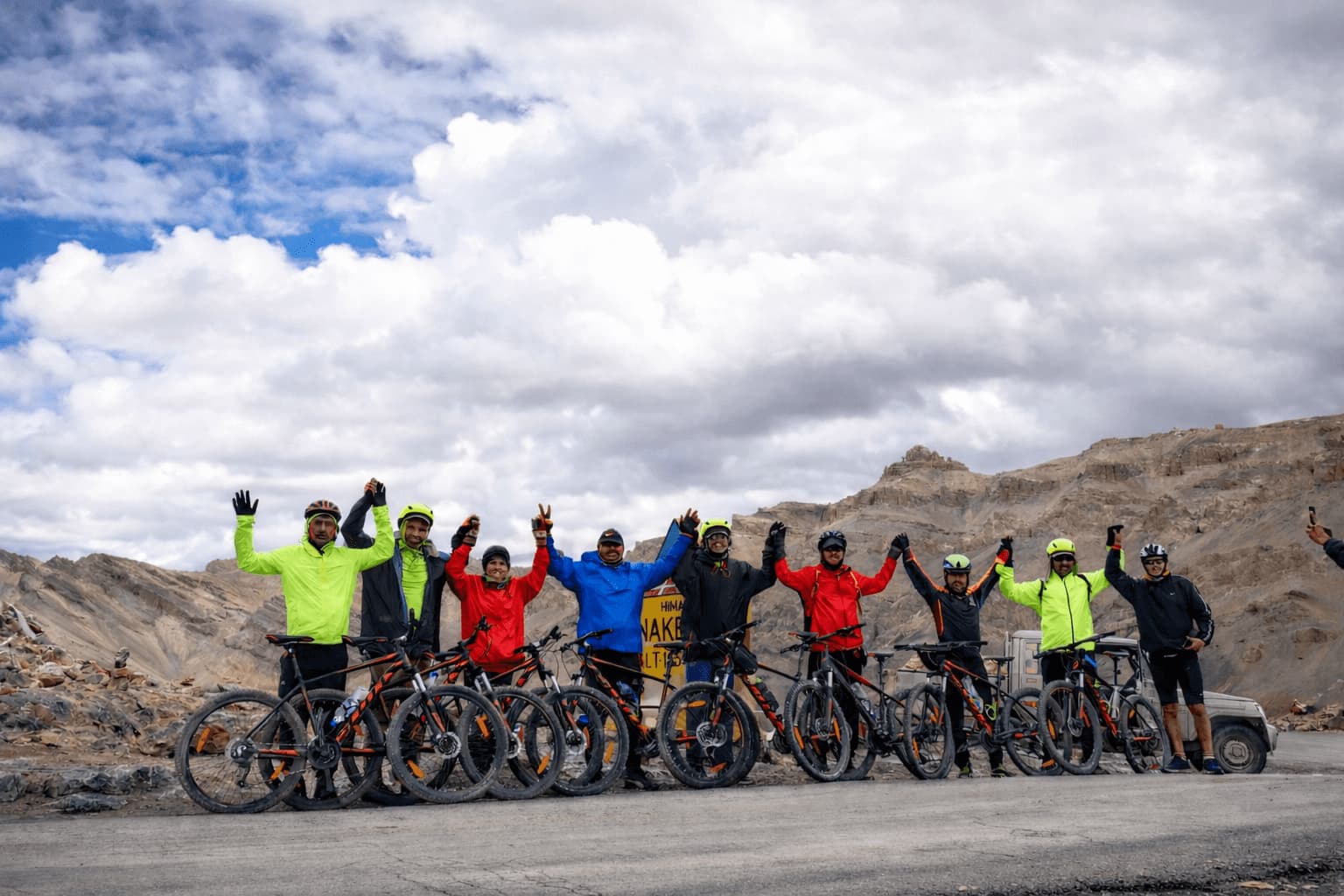
But the most important consideration is not simply the bike model. It is whether the bike is properly fitted, mechanically reliable, geared appropriately for sustained climbing, equipped with suitable tyres, and supported by spare parts and mechanical assistance. On a remote Himalayan expedition, mechanical support can become just as important as the original bicycle specification.
Our Manali–Zanskar–Leh expedition includes a mountain bike, mechanical support and spare parts, an English-speaking tour leader, an MTB mechanic and support crew.
Guided or Self-Supported: Which Is Better for the Himalayas?
This depends on your experience and the route. A strong cyclist with significant Himalayan experience may prefer a self-supported adventure. But remote high-altitude routes introduce additional logistical problems:
- Navigation
- Accommodation
- Food
- Mechanical failures
- Luggage
- Weather changes
- Emergency response
- Route changes
- Local permits
- Vehicle logistics
On an expedition through remote Zanskar or Spiti, these considerations become much more significant. A supported expedition allows the cyclist to concentrate primarily on riding while the expedition team manages the logistical framework. Our cycling programmes use support vehicles and mountain staff, with the precise support arrangement varying by route and group size.
What Does a Support Vehicle Actually Do?
A support vehicle is not simply a taxi following cyclists. On a properly organised expedition, it can support:
- Luggage movement
- Spare bicycles and parts
- Mechanical assistance
- Food and hydration
- Rider assistance
- First-aid equipment
- Emergency response
- Changes caused by weather or road conditions
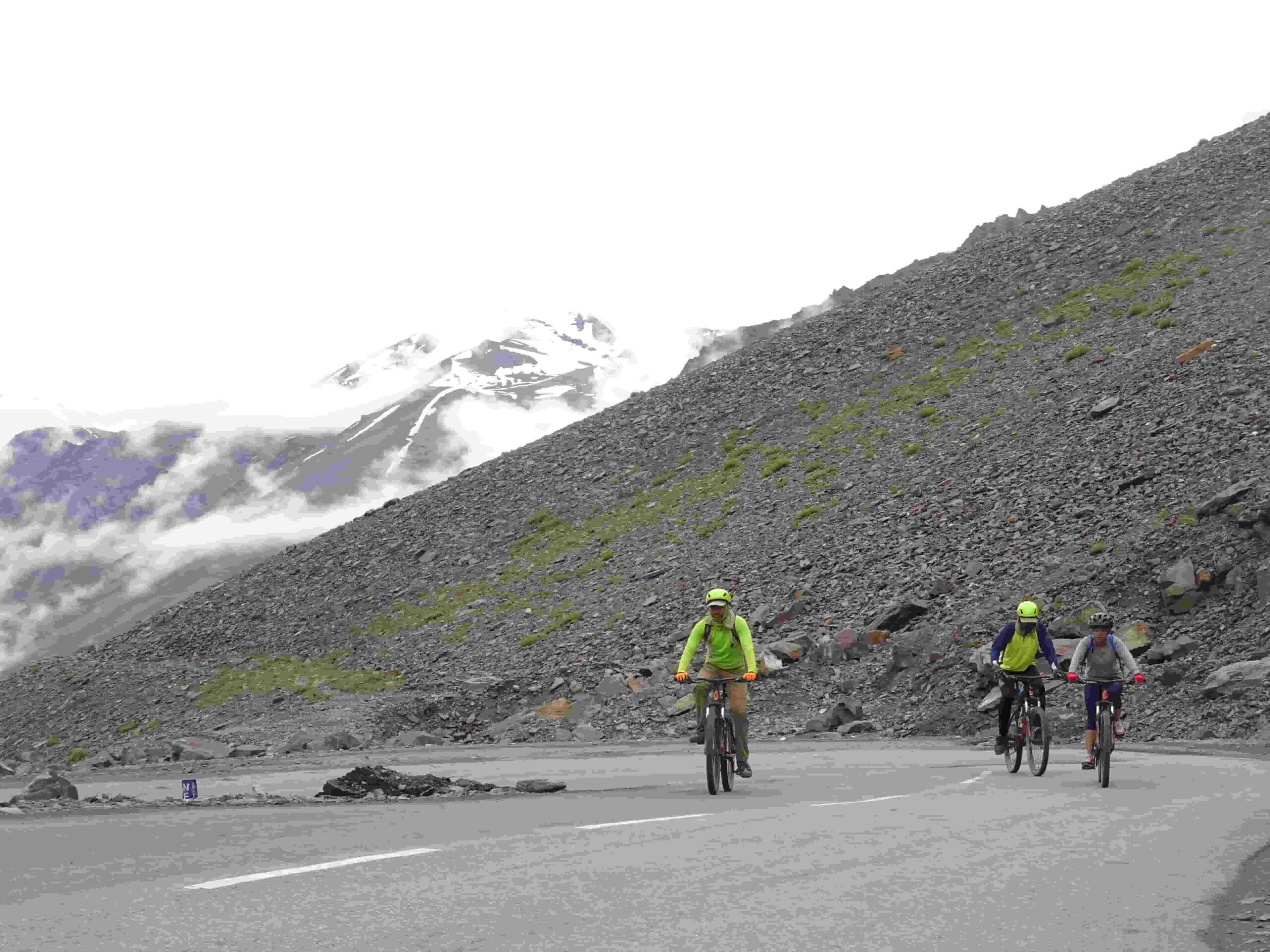
On the Manali–Zanskar–Leh expedition we currently specify support vehicles, an MTB mechanic, support crew and emergency equipment, with dedicated backup vehicle arrangements depending on group size. This is particularly important in remote sections where the next settlement or workshop may be many hours away.
When Is the Best Time to Cycle in the Himalayas?
The cycling season depends heavily on the route. The high Himalayan passes are seasonal because of snow and winter road closures. For the routes covered in this guide, the practical riding window is generally concentrated in the warmer months, but the exact season varies between Manali, Zanskar, Spiti and Ladakh.
We currently list July to September as the preferred period for the Manali–Zanskar–Leh cycling expedition because of the conditions around the high passes. However, cyclists should not treat a calendar month as a guarantee of road conditions. Before travelling, check pass openings, recent snowfall, road conditions, weather forecasts, local access restrictions, landslides, river crossings and current route conditions. This is another reason local expedition knowledge matters.
How Should You Train for a Himalayan Cycling Expedition?
Training should begin well before arrival in India. A useful preparation programme should include:
- Endurance. Build the ability to ride for several consecutive days rather than focusing only on one long ride.
- Climbing. Long sustained climbs are more important than short bursts of speed.
- Strength. Leg, core and upper-body strength help with long mountain days and rough terrain.
- Bike handling. Practise descending, cornering, braking, loose surfaces, switchbacks and climbing at low cadence.
- Back-to-back days. Your body should be accustomed to riding when it has not fully recovered from the previous day’s effort.
- Altitude preparation. If you live at low altitude, recognise that fitness does not eliminate the effects of altitude. Your itinerary needs to provide appropriate acclimatisation.
What Should You Pack for Himalayan Cycling?
A Himalayan cycling expedition needs to be packed differently from a normal cycling holiday. Essential categories include:
- Helmet
- Cycling gloves
- UV-protection sunglasses
- Hydration system
- Cycling shorts
- Base layers
- Fleece or insulated mid-layer
- Down or insulated jacket
- Waterproof shell
- Waterproof trousers
- Warm socks
- Gloves
- Headlamp
- Sunscreen
- Lip protection
- Personal medication
- Basic documents and travel insurance
Cold-weather equipment becomes particularly important once the route moves above 4,000 metres. For remote expeditions, your personal packing list should always be checked against the operator’s current equipment list.
Why Himalayan Cycling Is About More Than Cycling
One of the reasons international riders travel to the Indian Himalayas is that the bicycle becomes a way of moving through a landscape rather than simply completing a sporting challenge. A single expedition can connect Himalayan villages, Buddhist monasteries, high mountain passes, river valleys, high-altitude deserts, traditional communities, ancient trade routes and remote mountain landscapes.
The Manali–Zanskar–Leh route, for example, combines cycling with places such as Phuktal Monastery, Zangla, Lingshed and Lamayuru. The Spiti–Ladakh expedition similarly combines high-altitude cycling with places including Tabo, Dhankar, Ki and Tso Kar. This combination of physical challenge and cultural geography is what makes Himalayan cycling different from simply riding a long-distance road route.
Himalayan Cycling for Beginners: Where Should You Start?
Not every cyclist should begin with a 1,000-kilometre expedition. If you are new to mountain biking, developing technical skills first can be a much better approach. We currently operate a six-day Beginner Mountain Biking Course in Manali covering bike handling, braking, gear shifting, uphill and downhill techniques, trail safety and mixed-terrain riding.
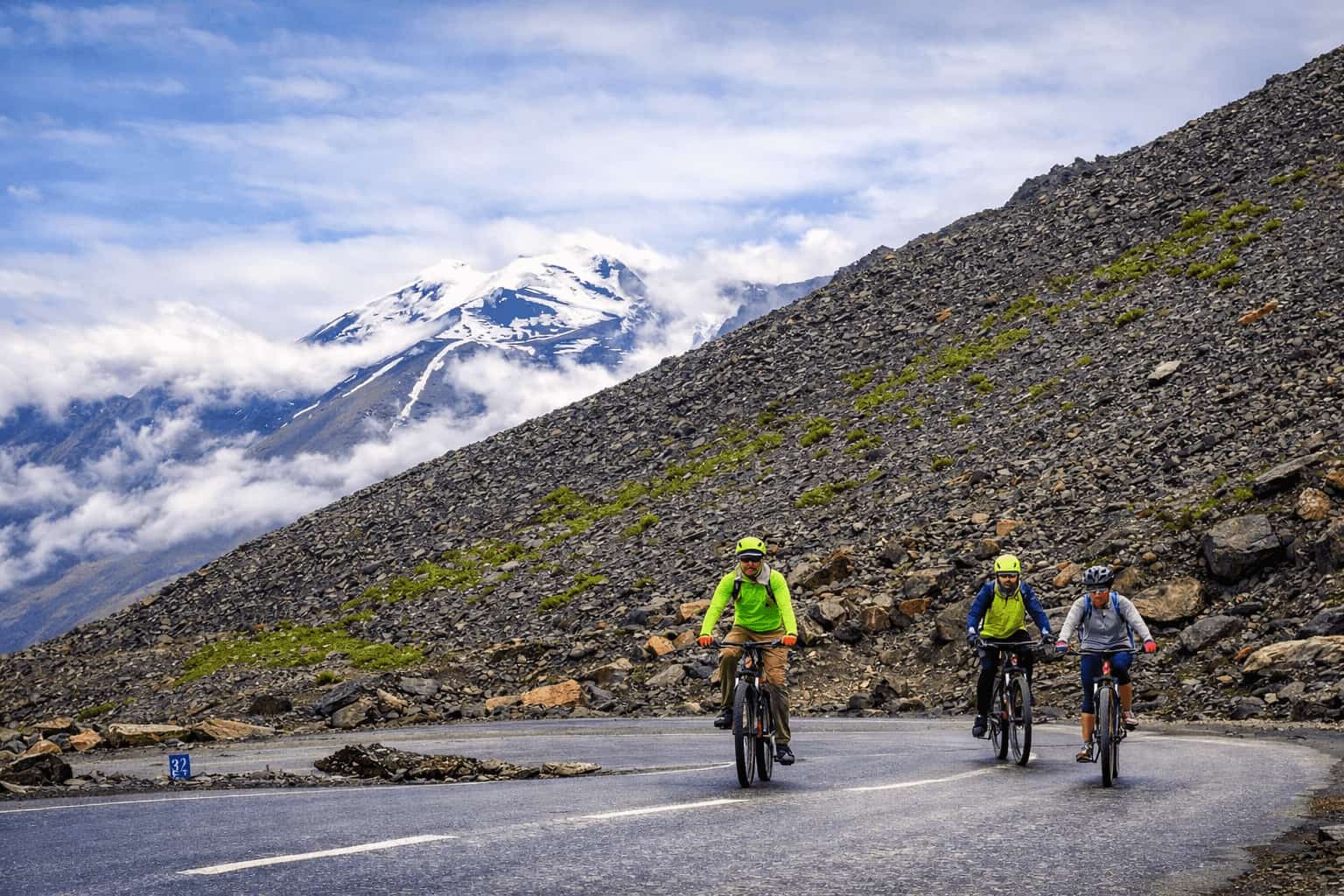
This creates a natural progression: beginner MTB skills → Himalayan mountain biking → high-altitude cycling → multi-day cycling expedition. The right starting point depends on your existing cycling background.
Manali Is More Than the Starting Point
For many international cyclists, Manali is simply the place where the expedition begins. But its position in the western Himalayas makes it much more useful than that. Around Manali, riders can develop mountain-bike skills, test equipment and become familiar with Himalayan riding before committing to a longer expedition. From here, routes extend towards Lahaul, Spiti, Zanskar and Ladakh, which makes Manali an important base for cyclists progressing from mountain biking into high-altitude expedition cycling.
How to Choose Your Himalayan Cycling Route
Before booking, ask yourself seven questions:
- How much Himalayan experience do I have? A strong road cyclist and an experienced mountain biker may require very different routes.
- What altitude have I previously cycled at? Do not underestimate the difference between cycling at home and cycling above 4,000 metres.
- Do I want a classic route or a remote expedition? Manali–Leh and Zanskar offer different experiences.
- How many days can I commit? Longer expeditions allow greater geographical variety but require more physical and logistical commitment.
- How much support do I want? Consider mechanics, backup vehicles, luggage transport, accommodation and emergency systems.
- What type of terrain do I enjoy? Road cycling, gravel, mountain roads and rougher terrain create very different experiences.
- What do I actually want to see? If your priority is Ladakh, choose accordingly. If your priority is remote Zanskar, the route should reflect that. If you want Spiti and Ladakh together, a longer expedition may be appropriate.
A Practical Comparison of Our Himalayan Cycling Experiences
Our current cycling portfolio allows riders to approach the Himalayas at different levels of commitment.
| Experience | Duration | Character | Max altitude listed | Best suited to |
|---|---|---|---|---|
| Beginner Mountain Biking Course, Manali | 6 days | Skills and trail riding | Manali ~2,050 m | Beginners |
| Pedal the Himalayas: Manali–Zanskar–Leh | 15 days | Challenging expedition, 658 km | 5,363 m | Experienced cyclists |
| Manali–Khardung La | 15 days | Difficult high-altitude expedition, 530 km | ~5,332 m | Experienced cyclists |
| Spiti–Ladakh Cycling Expedition | 23 days | Extreme long-distance expedition, 1,200 km | ~5,600 m | Strong, experienced cyclists |
The published figures and classifications are those currently shown on our product pages. Always check the live itinerary for the year you plan to travel.
The Himalayan Cycling Route Is Only Half the Expedition
Choosing the route is the first step. The more important question is whether the route matches your experience, preparation and expectations. A Himalayan cycling expedition should be planned around the realities of the mountains: altitude, terrain, weather, distance, acclimatisation, logistics and rider experience.
That is why route research matters. The famous name of a pass or valley can tell you where you are going, but it does not tell you what the ride will actually require.
For international cyclists looking beyond conventional cycling holidays, the Indian Himalayas offer an extraordinary range of possibilities — from learning mountain-bike skills around Manali to crossing high passes between Himachal Pradesh, Zanskar, Spiti and Ladakh. The key is choosing the route that matches the rider.
At Into Wild Himalaya Expeditions, our Himalayan cycling journeys are built around that principle: experienced mountain leadership, route knowledge, practical logistics and support designed around the realities of riding in remote high-altitude terrain.
Explore our Himalayan cycling routes and find the expedition that matches your experience, ambitions and appetite for adventure, or talk to our team about dates and route choice.
Frequently Asked Questions About Himalayan Cycling Routes
There is no single route that suits every cyclist. Manali–Leh is the classic high-altitude journey, while Zanskar and Spiti–Ladakh offer more remote and expedition-oriented experiences.
Difficulty depends on altitude, distance, elevation gain, terrain, weather, route remoteness and the cyclist’s experience. A relatively short stage can be extremely demanding at high altitude.
The exact distance varies according to the route and side sections, but the Manali–Leh corridor is generally around 475–500 kilometres.
The route reaches above 5,000 metres, with Tanglang La commonly listed around 5,328 metres. Exact route measurements can vary between sources and road alignments.
Yes, but beginners should distinguish between learning mountain biking and attempting a high-altitude expedition. Manali offers a useful environment for developing mountain-bike skills before progressing to longer Himalayan routes.
The practical season varies by route and pass conditions. Most high-altitude cycling expeditions operate during the warmer months when the major passes are accessible. Always check current road and weather conditions before departure.
It is not mandatory for every route, but support becomes increasingly valuable as the route becomes more remote and high-altitude. It can provide luggage transport, mechanical assistance, emergency support and logistical flexibility.
Not necessarily in every respect, but Zanskar routes can involve more remote terrain, rougher surfaces and greater logistical complexity. The actual difficulty depends on the itinerary, conditions and rider.
Yes. Routes can connect Manali with Zanskar and continue towards Leh, but the exact route, road status and seasonal access should be checked for the year of travel.
You should be comfortable with sustained climbing, long riding days and consecutive days on the bicycle. For extreme expeditions such as Spiti–Ladakh, substantial endurance and previous mountain-cycling experience are appropriate.


