
Hemis Festival, or Hemis Tsechu, is a two day masked dance festival at Hemis Monastery about 45 km from Leh in Ladakh, marking the birth anniversary of Guru Padmasambhava. It falls on 13 and 14 July 2027. The dates shift every year because they follow the Tibetan lunar calendar.
Hemis is the biggest monastic festival in Ladakh and the one most visitors try to see. It is also the one most visitors get wrong, usually by booking flights to the dates it fell on last year, or by flying into Leh the day before and spending the festival in bed with a headache at 3,500 m.
Both problems are avoidable. Here’s what the festival is, when it is, and what attending it actually requires.
What Hemis Tsechu Actually Is
Hemis Monastery belongs to the Drukpa lineage of Tibetan Buddhism and sits in a side valley above the Indus, southeast of Leh. It’s one of the wealthiest and most important monasteries in Ladakh.
Tsechu means the tenth day of a Tibetan lunar month. The tenth day of the fifth and tenth months are both associated with Guru Padmasambhava, the eighth century master credited with establishing Buddhism in Tibet and known in Ladakh as Guru Rinpoche. Hemis holds its festival on the tenth and eleventh days of the fifth month, which is why it lands in June or July in the Gregorian calendar.
The important thing to understand before you go: this is a religious observance, not an event laid on for tourists. The monks are performing liturgy. Visitors are welcome and the monastery is used to them, but nothing is staged for the cameras and nothing waits for a better angle.
The Dates, and Why They Move
The Tibetan calendar is lunar, so festival dates drift against the Gregorian calendar by roughly 11 days a year, with occasional leap months correcting the slide. That’s why Hemis can be in late June one year and mid July the next.
| Year | Hemis Tsechu |
|---|---|
| 2026 | 24 and 25 June |
| 2027 | 13 and 14 July |
Two practical warnings about dates.
Don’t trust a travel article without a year on it. A large proportion of the Hemis content online quotes dates from whichever year it was written and never gets updated. If a page gives dates but no year, ignore it.
Confirm before booking non refundable flights. The Ladakh administration publishes the monastic festival calendar and it’s the source worth using. Published dates occasionally differ by a day between sources, and the monastery itself is the final authority.
What Happens Over the Two Days
The festival runs across two days in the main courtyard of the monastery, with the head lama presiding and the monastic orchestra playing throughout: long horns, cymbals, drums and shawms. It is extremely loud, and that’s the point.
The Cham Dances
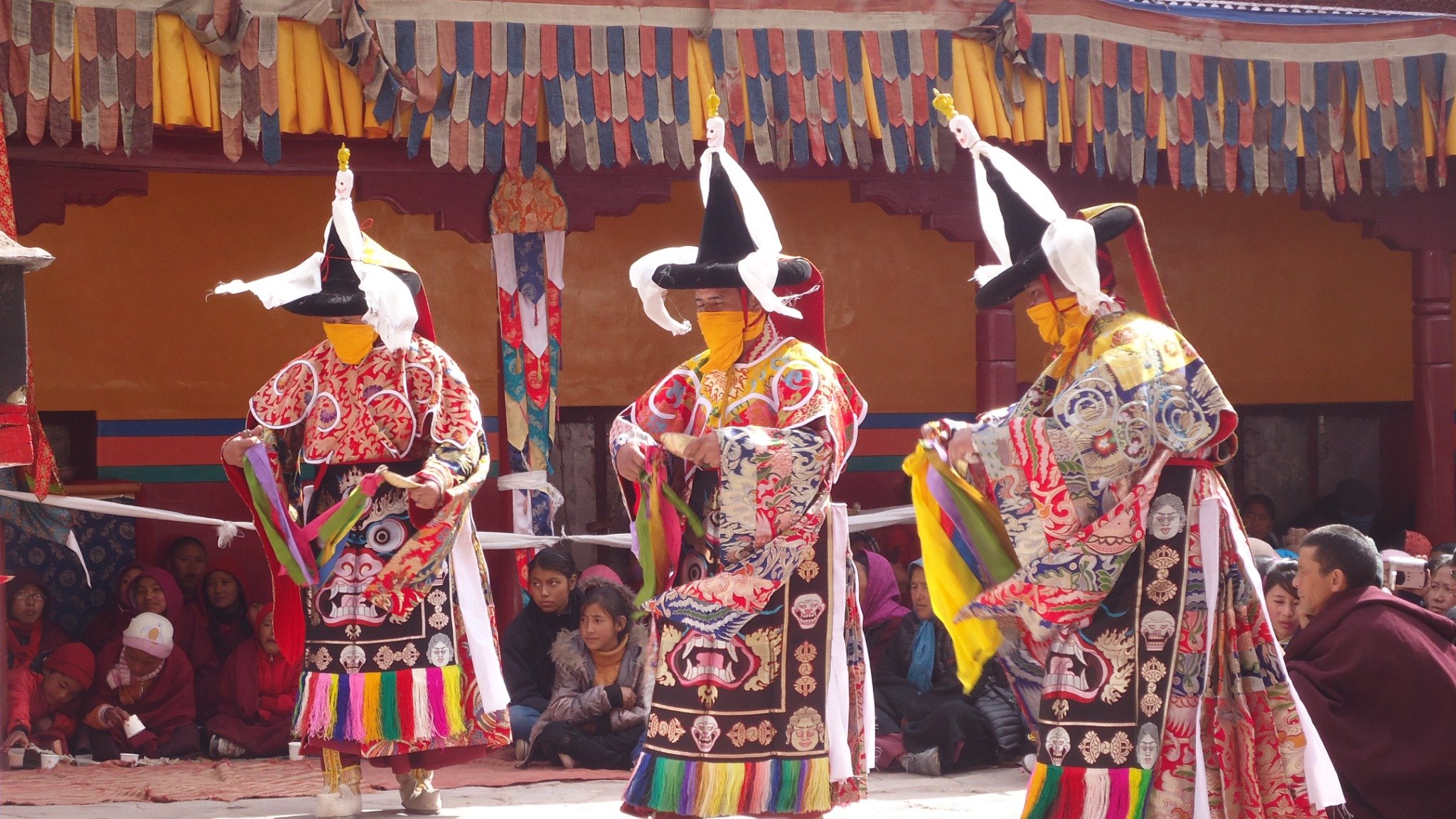
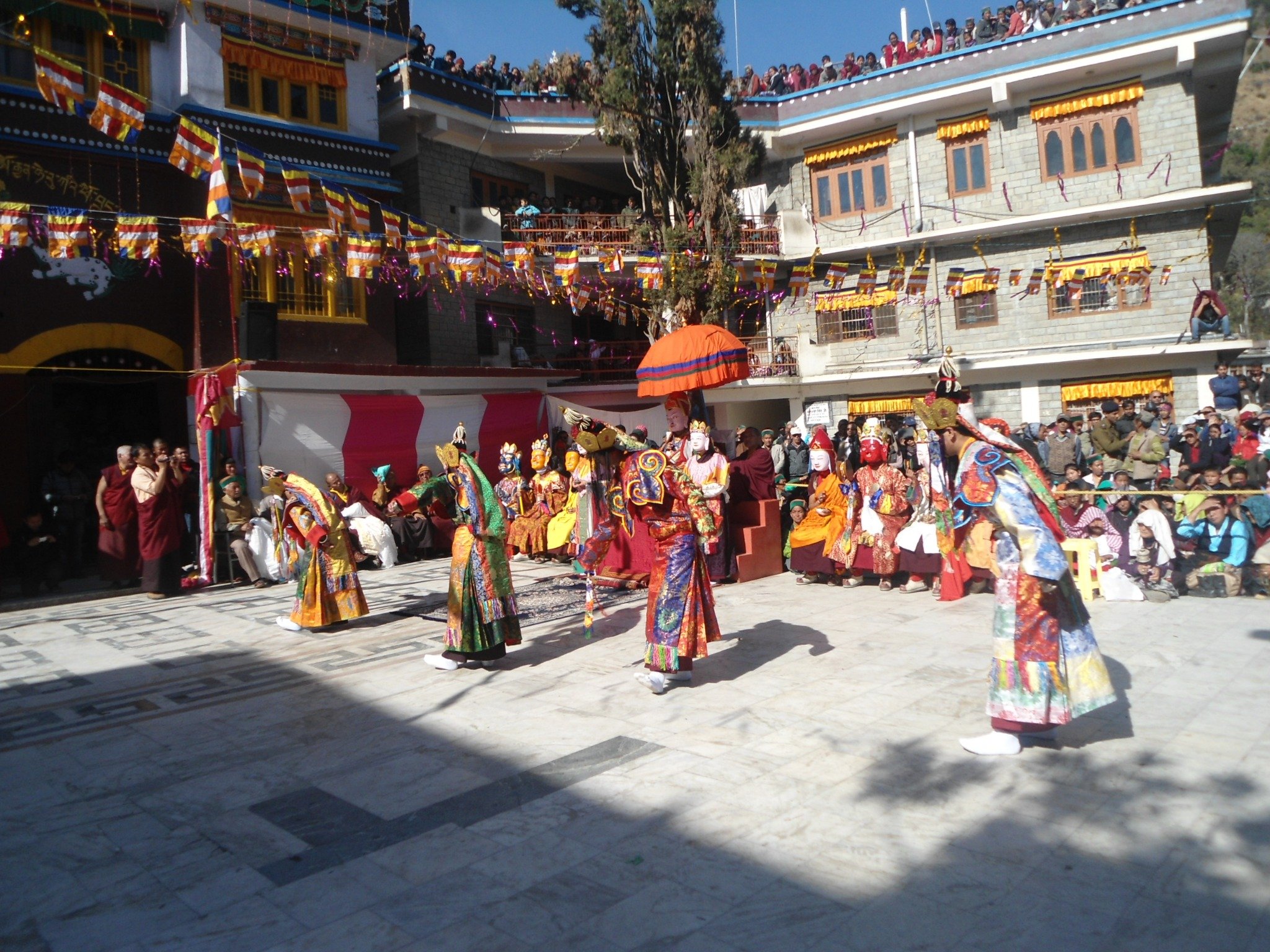
The centre of the festival is Cham, sacred masked dance. Monks in heavy silk brocade and large painted masks move through slow, precise, choreographed sequences. Each mask is a specific deity, protector or figure, and each sequence enacts a particular episode.
It is not fast and it is not obviously dramatic to an outsider. Watching it as spectacle, people get restless in the first hour. Watching it knowing what’s being depicted, it holds you for the whole day. Which is a reason to read something about it before you arrive, or to go with someone who can explain what you’re looking at as it happens.
The Eight Manifestations
The central narrative cycle depicts Padmasambhava’s eight manifestations and their victory over forces hostile to the dharma. The masks representing wrathful protectors are the ones in most of the photographs: enormous, fanged, multi coloured and genuinely startling at close range.
The theme is the same across Tibetan Buddhist festivals of this kind, which is the triumph of wisdom over ignorance, rendered as a battle because that’s a story people can hold on to.
The Effigy
At a culminating point in the cycle an effigy representing negative forces is ritually destroyed. It is the moment the whole festival builds towards, the crowd knows it’s coming, and the atmosphere changes noticeably when it does.
The Giant Thangka, and Why 2028 Matters
Hemis holds a thangka of Padmasambhava two storeys high, embroidered with pearls and semi precious stones. It is unrolled and displayed publicly only once every 12 years, in the Tibetan Year of the Monkey.
It was shown in 2004 and again in 2016 on that cycle, which places the next display in 2028.
If seeing it matters to you, that’s the year to plan around, and it’s worth confirming directly with the monastery closer to the time rather than relying on secondary sources. It’s the single rarest thing in the Ladakhi festival calendar and accommodation in Leh for a Monkey year Hemis will go early.
How to Actually Attend
Getting to Leh
Fly. Leh has daily flights from Delhi and the flight itself is one of the better ones anywhere, straight over the main Himalayan range.
The alternative is the road from Manali or Srinagar, two days either way, which has the significant advantage of gaining altitude gradually. If you have the time, it’s the better approach for your body and a far better trip. In mid July both roads are normally open.
Acclimatise First, and Treat This as Non Negotiable
Leh sits at around 3,500 m. Flying in from sea level puts you at that altitude in about 90 minutes, which your body has no mechanism to cope with quickly.
Guidance from the CDC is clear that fitness has no bearing on who develops acute mountain sickness. Rate of ascent and sleeping altitude are what matter. Marathon runners get it. People who’ve never exercised don’t.
The practical version: give yourself a minimum of two full days in Leh doing as little as possible before the festival. No hiking, no monastery circuits, no late nights, plenty of water. People who land on the 12th and go to Hemis on the 13th routinely spend the festival feeling awful, and a proportion of them need to come down.
Our Ladakh itinerary builds the acclimatisation in deliberately and reaches Hemis on day three rather than day one. That ordering is not an accident.
Getting to the Monastery on the Day
Hemis is roughly 45 km from Leh, about an hour and a half by road depending on traffic, which on festival mornings is considerable.
Shared taxis and buses run, and in festival season they fill early. A private vehicle arranged the day before is worth the money because it means you leave when you intend to. Expect to park some distance below the monastery and walk up.
When to Arrive and Where to Sit
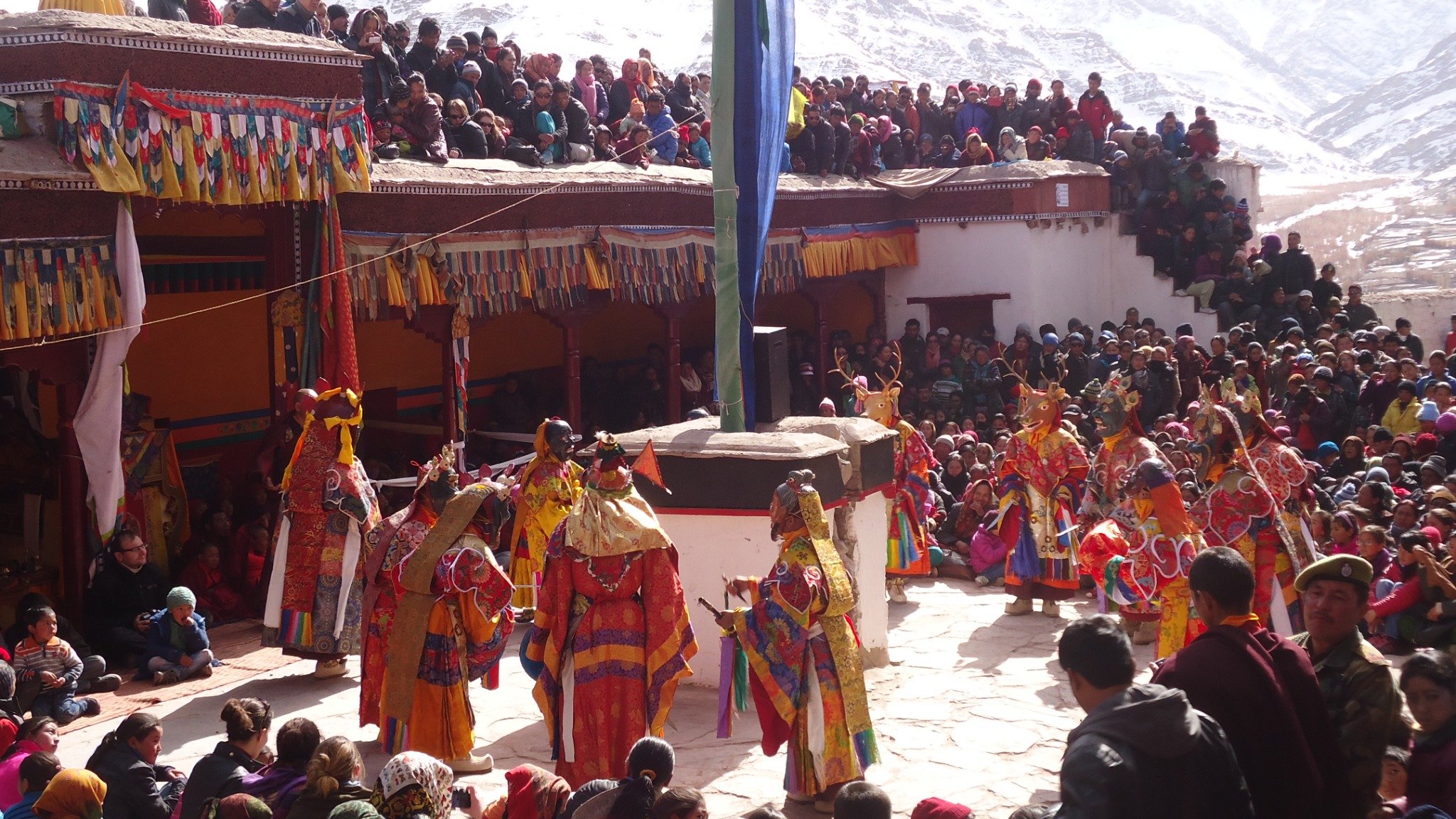
Arrive early. Proceedings generally begin mid morning and the courtyard fills well before that. The galleries and the raised edges of the courtyard are where the usable viewing positions are, and they go to whoever got there first.
If you want photographs, early arrival is the entire strategy. There is no second chance at a position once the courtyard is full, and the courtyard is not large.
Bring a hat, sunscreen, water and something to sit on. The Ladakhi sun at 3,600 m is ferocious even when the air is cool, and you’ll be in one position for several hours.
Permits
Hemis is in Leh district on the main Indus valley road and needs no Inner Line Permit. Permits in Ladakh apply to the border areas, which is Nubra, Pangong, Tso Moriri and Dah Hanu, not the Leh to Hemis stretch.
If you’re combining the festival with any of those, the permit is arranged in Leh and is straightforward, and any operator will handle it.
Etiquette and Photography
A short list, all of it the kind of thing that’s obvious once said.
- Dress modestly. Shoulders and knees covered. This is a working monastery.
- Remove shoes where indicated, which is inside the temple buildings rather than the courtyard.
- Don’t cross the dance floor or step into the performance space, at any point, for any photograph.
- Walk clockwise around shrines and stupas.
- Ask before photographing monks or local families close up. Almost everyone says yes. Asking is the point.
- Flash towards the dancers is both rude and pointless at that distance.
- Stand when the local crowd stands.
- Don’t leave in the middle of a sequence if you can avoid it.
The single best piece of advice is to put the camera down for the last hour and just watch. Most people’s strongest memory of Hemis is not a photograph they took.
What Else Is On Around the Same Time
July is dense with monastic festivals in Ladakh, which makes it the most rewarding month to be there if culture is why you’ve come.
| 2027 festival | Monastery | Dates |
|---|---|---|
| Yuru Kabgyat | Lamayuru | 1 and 2 July |
| Hemis Tsechu | Hemis | 13 and 14 July |
| Shachukul Kabgyat | Shachukul | 20 and 21 July |
| Stongde Gustor | Stongde, Zanskar | 21 and 22 July |
| Phyang Tsedup | Phyang | 31 July and 1 August |
| Karsha Gustor | Karsha, Zanskar | 31 July and 1 August |
Two of those are in Zanskar, which is a long drive from Leh and a trip in its own right. Lamayuru and Phyang are comfortable day trips.
A fortnight in mid July 2027 could take in Lamayuru, Hemis and Phyang without rushing, which is a considerably richer trip than flying in for Hemis alone.
Booking a Hemis Festival Trip
Into Wild Himalaya Expeditions has operated in Ladakh and the Indian Himalayas since 2004.
Our Ladakh Festival and Cultural Tour runs 12 days, graded Easy, with a maximum group size of 12 and a high point of 3,500 m. It covers Hemis, Thiksey, Stok, Spituk, Lamayuru, Alchi, Likir, Basgo, Rizong and Phyang, with the acclimatisation days built in at the start rather than tacked on. It’s currently ₹105,000 per person, reduced from ₹150,000.
If you want the itinerary timed so that the festival falls inside it, say so when you enquire. Fixed departure dates don’t always coincide with Hemis, and getting that alignment right is the whole reason to book a cultural itinerary rather than a sightseeing one.
Talk to our team about dates for 2027, or about 2028 if the thangka is what you’re after.
If Ladakh in winter interests you more than Ladakh in festival season, our guide to Spiti in winter and snow leopard season covers the other half of the year, including Hemis National Park, which shares its name with the monastery and is one of the best places in the world to look for snow leopard.
Frequently Asked Questions
When Is Hemis Festival 2027?
13 and 14 July 2027. The festival runs two days at Hemis Monastery, about 45 km from Leh. Dates move each year because they follow the Tibetan lunar calendar, so always confirm against the current year’s published Ladakh festival calendar before booking flights.
What Is Hemis Festival?
A two day masked dance festival at Hemis Monastery in Ladakh, marking the birth anniversary of Guru Padmasambhava. Monks perform Cham, sacred masked dance, depicting Padmasambhava’s eight manifestations and their victory over forces hostile to Buddhism, accompanied by the monastic orchestra.
Why Do Hemis Festival Dates Change Every Year?
Because they’re set by the Tibetan lunar calendar, not the Gregorian one. Hemis falls on the tenth and eleventh days of the fifth Tibetan month, which drifts by around 11 days a year against the Western calendar. It was 24 and 25 June in 2026 and is 13 and 14 July in 2027.
Where Is Hemis Monastery?
In a side valley above the Indus, roughly 45 km southeast of Leh in Ladakh, India. The drive takes about an hour and a half and considerably longer on festival mornings. It belongs to the Drukpa lineage of Tibetan Buddhism.
When Is the Giant Thangka at Hemis Displayed?
Once every 12 years, in the Tibetan Year of the Monkey. The two storey thangka of Padmasambhava, embroidered with pearls and semi precious stones, was displayed in 2004 and 2016, which places the next showing in 2028. Confirm with the monastery closer to the time.
Do You Need a Permit for Hemis Festival?
No. Hemis is in Leh district on the main Indus valley road and needs no Inner Line Permit. Permits apply to Ladakh’s border areas such as Nubra, Pangong and Tso Moriri, and are arranged easily in Leh if you’re combining the festival with those.
How Do You Get to Hemis Festival?
Fly to Leh from Delhi, then travel the 45 km to the monastery by road. A private vehicle booked the day before is worth it because festival morning traffic is heavy and shared transport fills early. Expect to park below the monastery and walk up.
How Many Days Do You Need in Leh Before Hemis Festival?
At least two full days doing very little. Leh is at around 3,500 m and flying in from sea level gives your body no time to adjust. Fitness has no bearing on who gets altitude sickness. Rate of ascent and sleeping altitude do.
What Should You Wear to Hemis Festival?
Modest clothing with shoulders and knees covered, since this is a working monastery. Add a hat, sunglasses, high factor sunscreen and layers. The air at 3,600 m is cool while the sun is severe, and you’ll be sitting in one position for several hours.
Can You Photograph Hemis Festival?
Yes, and photography is accepted. Arrive early, because viewing positions in the courtyard are gone well before proceedings start. Never step into the dance space, don’t use flash towards the dancers, and ask before photographing monks or local families at close range.


